You can now instruct Facebook to encrypt every email it sends to you so nobody — not even the NSA — is likely to be able to read your messages anytime soon. All you have to do is import your public PGP key into your Facebook settings and you’re good to go. The problem here, of course, is that most people have no idea how public/private key email encryption works and how to… Read MoreMonday, June 1, 2015
Facebook Now Supports PGP To Send You Encrypted Emails
You can now instruct Facebook to encrypt every email it sends to you so nobody — not even the NSA — is likely to be able to read your messages anytime soon. All you have to do is import your public PGP key into your Facebook settings and you’re good to go. The problem here, of course, is that most people have no idea how public/private key email encryption works and how to… Read MoreIt’s Time to Kill These 8 Deadly Online Marketing Myths
There is a remarkable contingent of marketers still harboring unrealistic and often dangerous expectations based on certain erroneous principles that are supposed to lead to online marketing success.
The result is either a lack of preparedness for what’s required to execute a marketing strategy and build a lasting, successful online business or a misunderstanding of how to prioritize limited resources to improve ROI, or both.
Therefore, many businesses ultimately suffocate before ever having a real chance to thrive.
Yet, many of the same old myths and misconceptions are still pervasive today. Perhaps some are even perpetuated by certain vendors or service providers that target those who don‘t know any better.
In this post, we’ll put an end to the most egregious marketing myths once and for all, so you can stay focused on what will actually drive real business growth.
Myth #1: People will buy our product because it’s cheaper than the competition’s.
Cheap prices don’t automatically translate into massive word-of-mouth, PR, and market share. People have to actually know you exist. Offering a cheaper price than your big name competition doesn’t do any good if no one knows about you.
Expecting orders to roll in because your ecommerce site sells some products for less than Amazon.com, or your SaaS offers the same features at a lower price than the 100-pound gorilla in your space, is delusional. You still have to create awareness using fundamental online marketing tactics. And you still have to convey a sense of trust and value that goes beyond just offering similar products or features as a competitor at a lower price.
While you’re digesting that, think about this:
Can your company still offer such low pricing after you factor in the time and expense associated with creating awareness of your site?
You’re setting your business up for even more problems when you primarily focus on price. It leads to getting the type of customer you’re asking for: price shoppers.
Alex Turnbull from Groove (which sells a customer service SAAS product) puts it well:
“[Price shoppers are] higher maintenance, far less loyal, and gone at the drop of a hat when a cheaper option comes along. Plus, if you try to compete for customers on price, a bigger player can always lower their prices to bleed you out of business. We learned that we had to compete on other differentiators. Ones that actually made people want to do business with us because we were the best choice for them, not because we were the cheapest. We needed customers who were motivated by more than price.”
Myth #2: We need to get as many people as possible to our website.
There is a big difference between getting traffic and getting the right kind of traffic, especially if you’re spending time (SEO, social, content marketing) and money (PPC, PR, advertising) to generate it.
Which is better: getting 100 highly targeted visitors, of which 15 become leads, or 1000 wide-ranging visitors, of which 5 become leads?
Why focus all your effort on a long-shot article in some mass-media publication? A mention on a niche, industry site might provide you with a greater number of real, qualified prospects, while also being far easier to achieve.
When sales are lacking, “all we need is more clicks to our site” is not the solution to your problem.
You could get (i.e., buy) hundreds of thousands of visitors to your website and not make a single sale. No matter what you’re selling, unless you have the right people – your target audience – coming to your website, it’s not going to do you any good.
Myth #3: Our product is so good, we don’t need to do any marketing.
“If you build it, they will come” only worked in the movie Field of Dreams.
I cringe every time I hear the words “Our company’s product/idea/website is awesome. All we need to do is post on social media and send out a couple of press releases and everyone will want it. It’s definitely going viral!”
The expectation of your business going viral, or even a slight reliance on that happening, is simply not a marketing plan.
While the internet offers a great and (sometimes) inexpensive medium to get the word out about your company to a potentially large audience, you’re competing with the millions of other companies and websites all vying for attention, mind-share, and wallet-share.
When Apple released the iPhone, a game-changing and widely publicized product, they still spent millions (and later billions) on marketing.
That doesn’t mean you shouldn’t try to create viral elements as part of your product or marketing efforts. And a great product certainly helps spread word-of-mouth. But don’t stand around waiting for lightning to strike.
Moreover, all that’s just to get people to your site. Once they get there, how many are likely to buy on the first visit? With average retail conversion rates of 1-3%, it’s like expecting to get married on the first date.
Marketing doesn’t end once the visitor gets to your site. You must continuously stay top-of-mind, engage them, and reinforce your unique value propositions to nurture them through the sales funnel, from awareness to actual purchase.
Myth #4: No one reads commercial emails these days.
Do you think email is dead? Here are a few recent stats that would say otherwise:
According to McKinsey & Company:
“E-mail remains a significantly more effective way to acquire customers than social media – nearly 40 times that of Facebook and Twitter combined. That’s because 91 percent of all US consumers still use e-mail daily, and the rate at which e-mails prompt purchases is not only estimated to be at least three times that of social media, but the average order value is also 17 percent higher.”
Also, a 2014 study by Experian showed that for every $1 spent on email marketing, $44.25 is the average return on investment.
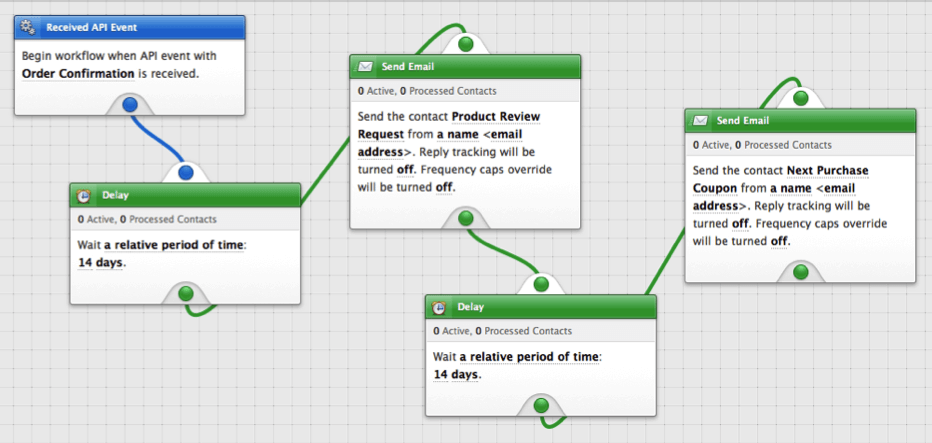
Be sure to use email automation. You can create dynamic, personalized, and highly scalable campaigns that are constantly working for your business in the background, sending personalized and targeted offers, nurturing leads, and much more.
Sample Post-Purchase Automated Email Workflow (Image Credit)
So, while email marketing might not sound as sexy as the latest social media channel, it has a far wider reach, generates higher click-through rates, and offers greater total ROI than almost any other tactic.
Myth #5: Our site looks great, so our work is done.
Yes, you’ve developed a great-looking new site. Your colleagues and staff told you so.
You spent a long time crafting the copy. You think you could sell ice to Eskimos.
All done? Quite the opposite, in fact. Now the work really begins.
If you aren’t expecting to have to consistently create and promote great content and find ways to engage your target customer through a variety of channels outside your site to build traffic, the investment your company made in a pretty new site could be for nothing.
Readers of this blog know it’s not easy to build meaningful, lasting traffic. It’s time-consuming. So make sure you have allocated the time and budget to consistently execute a long-term marketing strategy.
And that’s not all. At the same time, you need to be constantly gathering, filtering, and acting on all the quantitative and qualitative data that allows you to start optimizing your site to better achieve your business goals, because the ROI on your traffic-acquisition efforts depends on the ability of your website to convert this traffic.
Don’t bet that your website is a traffic-magnet, conversion-sucking machine on day 1.
There is no shortage of tools that can help you gather and analyze data and assist you with your marketing, yet it’s alarming how many marketers are still relying on intuition. Click the graphic for 1,876 of them:
At least make sure you’ve got some of the basics covered:
- Analytics (Google Analytics*)
- Email and Automation (MailChimp*, AWeber)
- Social and Content Marketing (Buffer*, Buzzsumo*)
- SEO (SEMrush*, Moz Open Site Explorer*, Yoast*)
- Heatmaps, feedback polls, surveys, user session recording (Hotjar*, Qualaroo, Inspectlet*, ClickTale)
*Offers at least a limited free plan. Others offer a free trial.
Track. Analyze. Optimize. Repeat.
Myth #6: “X” worked for that company, so it will work for us, too.
Just because something worked for one company doesn’t mean that it will work for yours. Copying the Amazon.com website doesn’t make you Amazon.com. Even copying the placement of their search bar doesn’t mean it will work as well on your site.
This image is less than ⅓ of the Amazon Fire HD product page. The full page at actual size would be over 27 feet tall.
Would that work for everyone? Nope.
And selling a pair of shoes, plus donating a pair to charity, does not make you the next TOMS.
Unfortunately, you can’t just “borrow” ideas from other sites and expect the same results. Why? Because that company isn’t your company.
Your audience is different. Your value proposition is different. Other elements of your site are different. The industry landscape is different. Readers of this blog know that “best practices” don’t apply to everyone.
However, that doesn’t mean you have to constantly reinvent the wheel, because there are tried and true design elements, functionality features, and marketing methods that are a great starting point. It just means that, even if you see a design or marketing tactic working for a comparable company in your industry, it’s likely going to need tweaking before you can apply it to your own business.
Create a hypothesis. Then test and measure everything.
Myth #7: Everyone is using social media marketing, so our company needs to as well.
Some businesses feel the need to be on Facebook, Twitter, Instagram, Pinterest, LinkedIn, and Google+, not to mention Vine, Snapchat, Tumblr, and every other social media platform they can think of. It can’t hurt, right?
Not only might these channels not be where your target audience actually spends their time, but every time you create a profile, you’re committing yourself to both monitoring it and keeping it active. After all, what good is having a Facebook page when a customer or prospect sees your last post was in 2009?
Jumping on too many social channels is a waste of valuable time and resources. Figure out which platforms your target audience actually uses, and focus on those by actively participating and creating relevant, frequent content. Forget about the others. If you can’t do them right, you’re better off not doing them at all.
Myth #8: We can hire people to perform individual marketing tactics without a holistic strategy.
A modern online marketing strategy is not comprised of individual tactics executed independently. Rather, it involves a comprehensive approach, including:
- Finding and engaging your target audience wherever they may be online.
- Retaining their attention by creating a variety of touchpoints to reinforce your brand and credibility.
- Leading them through the sales/conversion funnel.
That is why it is so important to take a holistic approach to your marketing campaigns, ensuring that each component, including SEO, email, social media, content marketing, PPC, and more (and each person responsible for it, if you have a team), supports and empowers the others.
For example, a high quality blog helps your SEO, but also gives you quality content to share on social media and through your emails. And using the blog to leverage your position as a thought leader and authority can improve your website conversion rates, which increases the ROI on your PPC and all other marketing.
Performing marketing tactics independently without a cohesive strategy is like telling a basketball team they aren’t allowed to pass. Expecting each player to score on their own without allowing them to leverage the other assets on the court is not going to win you any games against a decent competitor.
Takeaway
Online marketing is a never-ending task. And anyone responsible for it, from an individual at a small company to a C-level executive leading a department, always wishes there were more hours in the day.
So it’s essential to stay focused on what will truly impact ROI. Knowing which tactics and strategies are a waste of time is as important as knowing which ones are crucial to pursue.
Hopefully, I’ve finally killed some of the persistent myths that result in unrealistic expectations and wasted efforts. If you’ve got any others to share, be sure to comment below.
About the Author: Michael Epstein founded an ecommerce business 15 years ago in his college apartment with $500, and generated over a million dollars in sales the first year. He continued to grow his company until it was acquired in 2013. He now advises other online companies, from startups to $100M+ retailers, on digital marketing strategy. Follow him on Twitter and LinkedIn, or visit his blog.
6 dad-centric Instagram accounts you must follow
It's never too early to celebrate dads. Now, with social tools like Instagram, Vine and Twitter, fathers are free to show the world why parenthood is divine. Whether they're snapping pics of their kids playing on the monkey bars or displaying some killer kitchen recipes, these dads are worthy of your follow.
For fathers, future fathers or people who simply get a kick out of dad-and-kid-related content, these Instagram accounts will surely suffice.
1@dad_beets
This dad's Instagram description really says it all: "Breaking bread, throwing down funky beets and having a good thyme. And that's no yolk." Read more...
More about Dads, Instagram, Social Media, Pics, and Family ParentingThe CMO Solution Guide to Leveraging New Technology and Marketing Platforms Webinar
The title of this post is a mouthful for sure but trust me, every word counts.
Whatever your plans are next Wednesday, June 10 make sure you have a half hour open at 10AM PST/ 1 PM EST for that is when Michael Williams, CMO of Grand Prix of America, and Jonathan Margulies, Managing Director of the Winterberry Group and yours truly will discuss the findings from our recently released eBook: The CMO Solution Guide to Leveraging New Technology and Marketing Platforms.
The fact is as CMOs work to satisfy the demands of Wall Street and Main Street by driving a seamless customer experience across all touch points, their digital marketing technology road is full of speed bumps and potholes.
That's where the he CMO Solution Guide to Leveraging New Technology and Marketing Platforms comes in - a much-needed travel guide for the journey to Modern Marketing.
Mark your calendars right now for sure-to-be engaging 30-minute webcast:
10AM PST / 1PM EST
A Unique Way to Grow Instagram #socialtoolkit
Super excited for the launch of @freshdirect‘s summer instavideo series! Good things come in a box. https://t.co/GwLQ7HwaHi
— Liz Kennedy (@LizzyLou2) May 30, 2015
Social Toolkit 29: Instagram FTW with Liz Kennedy. Check out the full podcast below or download it on Stitcher, iTunes, or Soundcloud to listen later.
Brought to you by:
Liz Kennedy, a social media strategist and content creator with a passion for all things digital, joins the Social Toolkit to talk to the Jasons about strategic Instagram growth, investing in Instagram as a channel, Fresh Direct’s best performing content, Instagram tools — along with… lead generation and Permission Data, 3 types of followers identified, and Liz’s first social media love.
- App of the week: Hitlist, offering great travel deals, to a lot of your more traveled to destinations. Within Hitlist you can build a list of the places you want to travel to and it will alert you when it’s the most affordable time to go.
- Instagram Strategy
- How FreshDirect grew their followers
- Investing in Instagram as a channel
- Best performing Instagram content for FreshDirect
- Tools for editing, creating, and publishing images to Instagram
- Lead generation on Facebook
- Permission Data
- The results FreshDirect are seeing through the use of Permission Data
- Acquiring followers that listen and engage
- 3 identified types of FreshDirect followers
- Lead generation through influencer marketing
- Liz’s first social media love
- A college thesis on Facebook
- Emailing Mark Zuckerberg
- How Liz is using Facebook now vs how she thought she would be using when writing thesis
Social Toolkit 29: Instagram FTW with Liz Kennedy. Subscribe on Stitcher, iTunes, or Soundcloud.
9 Tips to Dramatically Increase E-Commerce Sales with Killer Product Pages
Does anyone else have online shopping ADD? Maybe it’s just me, but I have no problem abandoning a shopping cart if something goes even the slightest bit astray. The other day I was contemplating purchasing a dress from Free People, but my shoulders tensed up at the thought of it not fitting properly. Who wants to pay for shipping just to have to repackage and return the darn thing? The convenience of online shopping can quickly turn into an inconvenient, time-wasting, and frustrating experience, which is probably why most of us have no problem abandoning potential purchases.
Yes, e-commerce can be a joyfully profitable industry to be in. Sales cycles are instant, unlike B2B industries where marketers have to nurture leads down a long sales funnel. On the other hand, shoppers have no problem turning to another brand if their products are positioned in a more convenient, glamorous, or financially friendly manner. Why should I order a vacuum cleaner from you if your competitor offers essentially the same product, but with free shipping and a 30-day money back guarantee?
Moral of the story, product pages can make or break an e-commerce transaction. If the shopper has the slightest doubt in their mind, you’ve lost them.
I recently chatted with HubSpot’s e-commerce marketing consultant and Sales Engineer, Steve Haase, who’s consulted with hundreds of e-commerce businesses for the past 3+ years, and has an impressive and diverse background from founding his own startup software company, being a full-time musician, to serving in the military. Haase enlightened me to some best practices that can really make or break an e-commerce product page.
#1: Put Your Shopper at Ease
Your product page needs to address any potential concerns or hesitations your potential buyer might have. Will these pants fit? How long is the battery life? Can I return this product? Are sizes accurate? These questions all need to be answered. “For example, if your product has to do with clothing, how can you put people at ease that it’s going to fit?” says Haase. “Is there a sizing chart or guide? The thing that will make people shop elsewhere is uncertainty.”
Brainstorm ways you can put your shopper at ease, by providing clear copy, visual guides, and instructions if a product needs assembly. Haase explains the thought process the typical online shopper has: “I need a Large, but do Larges run big? I don’t want a muscle T, but I don’t want it too baggy. Ahh, I don’t know, I’ll just go somewhere else.” We’ve all had this internal dialogue when shopping online.
Take a look at the example below from the children’s clothing site, Tooby Doo. It allows the shopper to select the “size chart” button, which then provides a pop-up sizing guide for those in doubt. The pop-up is nice since is doesn’t direct to a new page, but provides a compact and easy-to-read and understand sizing chart to put the shopper at ease.
#2: Customer Reviews are ABSOLUTELY CRITICAL
88% of consumers trust online reviews as much as personal recommendations, according to BrightLocal.
That’s right, we trust complete strangers as much as we trust our mothers.
Also, 70% of people consult reviews and ratings before purchasing, according to BusinessWeek.
Alright, we all know customer reviews are necessary so why don’t you have them on your product pages? Or perhaps you do, but are they impactful? This tip ties in nicely with the one above because it’s all about putting the consumer at ease. When it comes to e-commerce product pages, having reviews on each page should be a no-brainer.
Rent The Runway kills it when it comes to reviews. Almost all of their dresses have 30+ reviews, with pictures that include a granular level of detail from the shopper’s height, weight, size worn, usual size, overall fit, affair, body type, etc., to ensure the rental is the perfect fit for the occasion before reserving. I’m a loyal customer (yes, I even have a PRO account), largely due to this reason.
What if you’re having trouble getting your customers to review your products? Well, you need to remind them that their feedback is important to you through emails…
And subtle site reminders…
Alright, alright, I’ll review it.
#3: Craft Creative Copy
Strong on-page copy seems obvious, but you’d be surprised by the massive amount of product pages that have snooze-worthy copy. Perhaps, the company is more concerned with imagery then creative copy. Yes, gripping visual content like images and videos are crucial product page elements, but if the copy is crap, this can be a huge detriment to building excitement about a product. “How are you actually convincing someone to buy the thing?” says Haase. “If your copy is crap then your page is crap. Not providing insight into why they should be excited, and why they should believe in you, is a huge mistake.” Take a look at this copy for instance:
Slubs? Silhouette? Whipstiching? What does “whipstitching” even mean? Avoid the over-complicated language, and make your copy more fun and relatable. E-commerce is an industry where it’s easy to be creative, and not take yourself too seriously.
The e-commerce clothing store So Worth Loving provides some creative and compelling copy on every product page. Check out the one below:
“WARNING: this tee is so comfortable you may never want to take it off.” You had me at comfortable, SOLD!
#4: Create a Strong Sense of Urgency
The fastest way to get e-commerce conversions? SCARE TACTICS. You want to make every visitor nervous that if they don’t buy now they might miss out! I know, it sounds manipulative, and perhaps it is, but it works. “You just paid for the click so you need to convince them they don’t need to look anywhere else,” says Haase. “Investigate the elements of urgency and scarcity that you have on your checkout page. Are you running a special sale for a limited amount of time? What about availability?” Haase recommends implementing an inventory management system if you don’t have one already. This will allow you to provide inventory on the page so you can show when stock is low in turn giving the shopper more incentive to buy before it runs out.
Check out the example below from the e-commerce furniture store One Kings Lane, where their product page for a silver wall mirror emphasizes several urgency factors such as the 41% discount, the inventory 2 days left bookmark, and the small clock icon informing the shopper that the sale is about to end. Seriously, this is well done!
#5: Provide All Necessary Context
Find creative ways to provide as much information as possible to properly inform the shopper without overwhelming them with unorganized copy. “Any kind of instructional information needs to be included,” says Haase. “What’s the care? Is it dry clean only? I hate that, but you didn’t tell me so I’m going to go somewhere else.”
For example, if you’re selling a do-it-yourself (DIY) product there needs to be some sort of kit on assembly instructions. Perhaps an engaging time-lapse video. “Provide reinforcement for any of the objections that the person might have as they reach that page,” says Haase. One King’s Lane also does a great job at providing context. Just take a look at the example below. Each one of their product pages allows you to compare the piece of furniture to real-life objects, from anything from a French bulldog, to a wine bottle, to a standard door. This helps shoppers get a true idea of the size and dimensions of the furniture without leading them to doubt that buying online is the right choice.
#6: Experiment with Exit Intent Popovers
What are exit intent popovers? They’re those popups that appear before you leave a site, saying something like, “Are you leaving us already?” If you’re rolling your eyes and thinking ‘those are annoying,’ yes, I actually agree, but we use them at WordStream because we’ve found that they actually work.
“The worst investment of your dollar (from a paid click) is a 10 second brand impression,” says Haase. “If they’re not going to get the sale at least get the email. If they’re not ready to buy you can provide a pre-transactional offer, for example ‘Oh, I see you’re interested in weaving, get our free e-book to learn some new tactics.’”
#7: Leverage Social Sharing
Every product page should leverage the power of social media. Yes, your website should be promoting your brand’s social channels, but on product pages there should be social buttons allowing the shopper to share the product on platforms like Twitter and Facebook. For example, let’s say you’re shopping around for a new pair of boots during the holiday season, but you realize that the pair you want isn’t in your price range. An easy fix, tweet the product to a loved one with a subtle hint – “@mom, add this to the Christmas list J.” This makes it so that even if your shopper doesn’t go through with the transaction, there’s a chance they’ll promote it to their followers and perhaps convince others to buy from you.
Haase recommends using product hashtags to get people chatting about your products. “Social media helps put your products out there, and can drastically expand your reach,” he says.
Check out the example from Bed, Bath, and Beyond below.
#8: Ensure Your Product Pages are Mobile-Friendly
Yup! We get it. Mobile is important, we’ve all been hearing this for years now, but have you ever actually taken the time to search for your product pages on your iPhone? You might be unpleasantly surprised by the shopping experience. Well, mobile isn’t going aware. According to Google, there was a 175% growth in shopping searches on mobile in the first five months of the year. So people are searching for products on their phones, clicking on your ads or organic listing and being delivered to your site while on the way to work or while watching TV at night. This isn’t that surprising, right? You likely do this more then you even realize.
Need I say more? Mobile is big. We all know this. So stop living in denial and get your mobile act together already!
#9: Turn One-Time Shoppers into Loyal Customers
Lastly, conversions only go so far in e-commerce. Lots of products are affordable so in order to gain ROI from your marketing efforts there needs to be a large sum of transactions which occur on a regular basis. All e-commerce marketers should be thinking of ways to make their customers come back time and time again.
Haase told me about one his largest e-commerce clients, “The number one thing they spend their time on is tactics to make people come back. This is their job,” says Haase. “How can I get someone to buy more stuff? You need to answer that question, which comes down to your own creativity and strength of your business.” Haase recommends trying to build a relationship with each and every customer to through new, interesting, and fun experiences.
One company that Haase recommends learning from is BetaBrand: “They’re always coming up with new campaigns. They also know their persona and know what they’re looking for. Unless that’s happening, none of your marketing is going to do anything.”
Even just visiting BetaBrand’s site for the first time it’s clear that they do a lot of marketing to not only engage with their current customers, but also gain new customers through creative tactics. See the example below where they’re giving customers a $25 credit for each friend they refer, as well as the new customer $25 off on their first purchase.
Going along with this point, Haase also recommends implementing a marketing automation software to re-engage with past shoppers. “If you’re selling pet food, how long does it take to go through the container? Send an email a week before, follow up the week after.”
So there you have it. Implement these strategies to drastically grow your e-commerce transactions through better product pages. “Do the standard things, but in terms of what’s the next thing, ask what will help people? What is it that people are worried about? What do they like to do?”
About the Author:
Margot is a Content Marketing Specialist at WordStream with a background in PPC, SEM, content and digital marketing. Margot is passionate about writing and is also a regular contributor to socialmediatoday.com. She enjoys running and eating ice cream during her free time (not simultaneous although that would be impressive). Follow her on:
Twitter: @ChappyMargot
Google+: +Margot da Cunha
LinkedIn: http://www.linkedin.com/in/margotdacunha