Friday, July 3, 2015

3 ways to turn your brand into a social media juggernaut

Juggernaut_thumb
Feed-twFeed-fb

This article is part of SWOT Team, a series on Mashable that features insights from leaders in marketing, brand-building and public relations.

We all know it pays to have a large social media presence (this is a world where companies pay Kim Kardashian an estimated $20,000 per promotional tweet). But short of buying followers or other forms of subterfuge, how can you organically build a powerful following and become a social media juggernaut?

For my new book Stand Out, I interviewed technology opinion leader Robert Scoble, who has built a massive social media following, including more than 450,000 Twitter followers, 650,000 Facebook followers and friends and a whopping 6.6 million followers on Google+ Read more...

More about Google, Robert Scoble, Social Media, Business, and Small Business

How to Double Your Writing Speed Without Lowering Its Quality

writing

How in the world do they do it?

Day after day, they write monstrous posts that are extremely useful and easy to read.

You know the people I’m talking about—you might even consider me to be one of them.

Here’s what a typical week looks like for me in terms of blog content alone:

  • 2 posts on Quick Sprout (1,000-5,000 words each) plus an infographic
  • 2 posts on the NeilPatel.com blog (about 5,000 words each)
  • 2 guest posts on other popular blogs (about 1,500 words each)
  • 0.5-1 blog post for the Crazy Egg blog (about 2 per month at about 2,000 words each)

Total that up, and you get around 17,000 words per week or 3,400 words per weekday.

And I’ve been able to sustain this type of volume for years.

I’m the first to admit that in technical terms, I’m not the best writer. I certainly didn’t go to college to get a degree in English or creative writing. Yet, I have thousands of awesome readers who really enjoy what I write.

There’s a reason I spent much time learning first how to write quality blog posts and then how to write them fast.

Although time is my most valuable resource, I spend a significant chunk of it every week writing. That’s because I know how effective content marketing can be for a business.

But I’m far from the only one.

Contently found that 41% of businesses struggle with creating enough content.

image05

Wouldn’t it be easier to create more content if you could write faster?

If you need to learn how to write a great post, start by checking out my guide to writing high quality data-driven articles.

If you already write high quality posts but it takes you a long time to do it, then this article is for you. I’m going to show you 11 key concepts that you can start using today to start writing faster.

Imagine being able to write posts in half the time you currently do now! That would free up a lot of time to either write more posts or work on other parts of your business.

An extra few posts a week can greatly speed up your business’ growth, possibly by years. 

1. Get your typing up to speed

No matter how well you can remain focused for long period of times and how fast you can think of what to say, if you can’t type at a decent speed, you’ll never write quickly.

If you’re still pecking at letters, one finger at a time, it’s not going to cut it.

You don’t have to be a master typist, but you should be able to type at least 60 words per minute (60 WPM). If you could type at that speed for an hour straight, that would be 3,600 words per hour. Obviously that’s unrealistic, but you can achieve a decent fraction of that production rate.

I’d like you to take a minute to test your typing speed. Head to Key Hero, and do a quick typing test:

image07

If you’d like to repeat it a few times to get a more accurate result, go ahead.

If your speed is under 60 WPM, you’ll have to fix that before you can worry about any of the other concepts in this article. I know it’s not the most fun thing in the world, but you’ll be grateful you did it in the long run.

Step 1: Use the proper hand placement

To type properly, you should be resting the four fingers of each hand on the keys of the middle row, with your thumbs hovering over the space bar.

image02

If you don’t already do this, it will take a bit of practice for it to feel natural.

Step 2: Don’t look at the keyboard

You should be able to type with your eyes closed—literally. If you can’t, it means you need to practice to get you to the point when typing no longer requires an active focus (the unconscious takes care of it).

Part of this can be your posture. If you’re hunched over while sitting, it’s possible that you’re looking at the keyboard just because that’s where your line of sight is. Do your best to sit up straight when writing.

Step 3: Practice, practice, practice

Kids these days practice typing from a young age, but you might not have been so lucky. The good news is that you can find online tools to help you practice and learn. One example is the Key Hero practice tools. If you need more instruction from the beginning, use a typing tutor tool:

image00

Alternative: Try speech-to-text software

You have a number of speech-to-text tools you can use, e.g., TalkTyper (free), Ivona (paid), and Dragon Naturally Speaking (paid). These tools allow you to simply talk to your computer while it records your words and whatever punctuation you indicate.

While you can obviously talk faster than you can type, there are some downsides to this method. The free or cheap tools aren’t always accurate, and it can take a lot of time to fix the mistakes those programs make. Even the expensive ones aren’t perfect, and they also have a steep learning curve at first.

It’s not the first option I’d recommend, but if for some reason you aren’t able to type, or type quickly, it’s a decent backup.

2. Don’t forget your ideas: make a list

How much time do you waste trying to come up with a good idea for a blog post?

It’s hard enough if you’re just writing a couple of them a week, but if I had to come up with ideas for all the posts I write one at a time, I don’t know if I could do it.

The good news is: there’s a better way. It’s called an idea list.

Coming up with ideas on demand can be difficult because it’s a creative task. Creativity comes and goes as we observe and experience different things in our lives. It’s why book writers often take years to write their novels.

You can’t just sit down and say to yourself, “Okay brain, start coming up with great ideas.”

Instead, you need to develop your idea muscle so that you can spontaneously come up with many ideas throughout the day.

The concept of an idea muscle was coined by James Altucher, who says that as you practice coming up with ideas, you get better at it.

“Every situation you are in, you will have a ton of ideas. Any question  you are asked, you will know the response. Every meeting you are at, you will take the meeting so far out of the box you’ll be on another planet, if you are stuck on a desert highway – you will figure the way out, if you need to make money you’ll come up with 50 ideas to make  money, and so on.” — James Altucher

He advises to start by trying to come up with at least 10 ideas throughout the day.

Here’s the second part: record them. Not all of these ideas will be good, but some will be, and others may lead you to good ideas.

You can use a simple notepad from the dollar store, or you can do what the team at Buffer does and record ideas in Trello:

image09

An alternative: create a repeatable strategy

I’ve already shown you how to steal ideas for your next post. This is a strategy that you can use over and over again to get inspiration for post ideas.

It’s still not a good idea to come up with post ideas as you need them—it’s inefficient. Instead, schedule a block of time, maybe an hour, every week or month (depending on your post volume). Use this time to use your strategy to come up with as many ideas as you can.

Instead of coming up with a single idea in 10 minutes every time you need one, you can come up with five times the number of ideas in the same time frame once you get some momentum going.

Either way, you’ll be able to cut down on time coming up with ideas and focus more time and energy on the actual writing.

3. Get rid of distractions

Distractions are everywhere, especially on the computer.

The urge to check email, visit social media sites, or just click a bookmark to go to your favorite site to kill time is strong.

Maybe you’d rather check your search engine rankings again or website traffic instead of writing a post, which seems way less fun.

If you give into these urges, your productivity is going to go way down. But even if you don’t, those urges in the back of your head are going to distract you and prevent you from being as productive as possible.

In real life, there are even more distractions, especially if you work from home. Kids running around, people talking on the phone or watching TV, and temptation to take a break and grab a snack.

Distractions are everywhere.

You’ll never get rid of them all, but you can get rid of many, which will greatly boost your writing speed.

Distraction elimination #1: Work in an office or quiet space

Noise kills writing productivity. You need to be able to hear your thoughts uninterrupted. If you work from home, designate a room as your office, and make sure that no one disturbs you while the door is closed.

If you’re working at an office or co-working space, keep your door closed while writing. Tell any friends or coworkers to not disturb you while the door is closed unless there is an emergency.

If neither of those are realistic, head to a library. Libraries are quiet, and some even have dedicated rooms for silent work.

image03

Distraction elimination #2: Turn off the tunes

Who doesn’t like music? Wouldn’t it be more fun to write while listening to Taylor Swift?

Well, sure, it will be more fun, but it will slow you down when you are writing.

Studies have shown that music is a distraction that slows down complex thought processes. So while music might help you with simple, straight-forward tasks such as lifting more in the gym, it’s going to slow down your writing.

But that’s not the full story. Those studies looked typical lyrical music.

A 2012 study showed that low to moderate levels of ambient noise can actually lead to slightly higher creative output.

Similarly, another study showed that baroque classical music can increase mood and productivity. Note that classical music rarely has any lyrics. It is soft and consistent.

So you have two options: work with no music or work with low to medium volume ambient noise or classical music.

To have some ambient sound in the background, you can use tools such as A Soft Murmur or Simply Noise.

Distraction elimination #3: Lock-down distracting websites

If you have trouble staying on task, you can block certain trouble websites for a designated time period. There are many plugins that can do this, e.g., Strict Workflow for Chrome.

You simply tell the plugin which sites you’d like blocked and for how long, and you won’t be able to access them until the time period is up.

In addition, you can hide your bookmarks bar if you’re working inside a web text application such as Google Docs. Just right-click any empty space in the bookmarks bar and uncheck “show bookmarks bar.”

Distraction elimination #4: Write offline

If blocking distracting sites doesn’t work, you can take it to the next level and disconnect your Internet altogether. Writing offline will eliminate all online distractions.

Distraction elimination #5: Finish all important tasks before writing

Sometimes it’s hard to focus because there’s something else important that you need to do during the day. If you’re thinking about this in the back of your head, your writing speed will go down.

Instead, think about doing any distracting tasks upfront, and then come back to writing later.

4. Outline your post beforehand

Before I write any post, I always outline it.

When you outline a post, you get a really clear idea of how you will be making the point you’re trying to make as well as any research or resources you’ll need to make the article as strong as possible.

You’ll notice that all of my posts have an introduction section (like everyone else’s posts would have) and also a conclusion section.

The headlines of the other sections will depend on the type of post I’m writing. There are 12 main types of posts, and I have general outlines for all of them.

The outlines don’t need to take very long to put together. Their main point is to make sure you’re not missing any important pieces of the puzzle.

I write out all the subheadlines (H2s) in the article as well as a few main bullet points below each to remind me what I should cover.

image06

When I get to each section while writing, I don’t have to remember what I had in mind for this section before—it’s already there.

5. Research comes first

What do you think is easier to write about for me: how to ride a horse or how to write a good blog post?

Of course, how to write a good blog post is a simpler topic for me because it’s a topic that I have a lot of experience and expertise in.

The first step is to become an expert on the topic you’re writing about. It’s easy to talk/write about something you know well but difficult if you’re trying to put the pieces together as you go.

Take my nutrition blog case study. I’m not a nutrition expert, and I didn’t have the time to invest in becoming well-versed in the subject so that I could write about it credibly. That’s why I had Mike take over content creation.

This doesn’t mean you need to be an expert from day one, but you need at the very least to learn about the specific topic you’re writing about before starting.

Otherwise, task switching is going to kill your writing speed.

What’s task switching? It’s a concept that refers to having to switch between different activities. For example, having to switch from writing mode to research mode because you don’t understand a concept you need for a particular article.

While some may multitask better than others, we all are more productive when we focus on a single task.

Dr. David Meyer and colleagues conducted a study in 2001 to quantify the effects of task switching. He had subjects try to switch between different tasks such as solving math problems and naming geometric objects.

When both problems were simple, subjects didn’t lose much time going back and forth. But as the tasks became complex, the subjects lost more and more time with each switch.

It’s hard to pin down the exact cost of switching, but Meyer estimated that it could cost someone up to 40% of their productivity for complex tasks. Make no mistake, writing and researching are complex tasks.

Every time you have to switch, it not only takes a bit of time (up to a few seconds) to get into the right mindset, but it also fatigues you. Just thinking about having to switch back and forth several times an hour makes me tired.

Here’s the takeaway: learn everything you need to know about the topic you are writing about before you write a single word. This means that you should note down any relevant statistics, resources, or findings from studies beforehand.

6. Write first, edit later

Ernest Hemingway said, “The first draft of anything is garbage.”

I’m not sure how much fiction you read, but Hemingway was one of the most influential authors of the 20th century.

He won a Nobel Prize in Literature and a Pulitzer Prize for Fiction before he died. Even now, we remember his writing genius.

If Hemingway thought his first drafts were garbage, imagine what he’d think of mine or yours.

So, you basically have two options if you want to write a post that doesn’t suck.

First, you can continually edit each sentence and paragraph as you go. Or you can write your first draft like most prolific writers do, and then edit later.

Both can produce a good article, but I’ll tell you why the second option is by far the best choice.

If you continually switch between writing and editing, you have the same problem that we looked at before: task switching. You’re asking your brain to switch from trying to write to trying to edit. This kills any writing momentum you have and makes you start from scratch every sentence or paragraph.

When you write—just write—you can focus on writing only. This allows your mind to focus on what you should write now and what should come next. Similarly, when you’re editing, all your focus can be on “how can I make this better?” instead of also trying to think of what needs to be said next.

In my experience, Meyer’s guess of about a 40% decrease in productivity from task switching is probably about right.

Write first, edit second.

7. Take (smart) breaks

Unless you’re a robot, you need breaks. All people get tired.

Sure, you can get stronger over time, but you’ll still need breaks.

Everyone’s different in this aspect. Some need frequent breaks, while others only need breaks after a few hours. It depends on how much you enjoy writing, your writing ability, and a few personal factors.

If you’re not sure where to start, I recommend the Pomodoro Technique. Yes, pomodoro means “tomato” in Italian, so essentially it’s a tomato technique. It’s named after the timer that the creator used:

OLYMPUS DIGITAL CAMERA

It was designed in the 1980s by Francesco Cirillo. Even though it’s not new, it hasn’t been until the last decade or so that it really became popular as a productivity technique.

Here’s how it works:

  • You set a timer for 25 minutes
  • You work until the timer finishes
  • You take a 5 minute break
    • All of that is one Pomodoro

Now you repeat that process four times. After the 4th 30-minute period, you take a 15-20 minute break.

You can either buy a pomodoro timer or just use this online tomato timer.

This procedure is supposed to keep you focused and fresh while working.

image04

For accountability purposes, you are supposed to start the day by making a to-do list of what you’d like to accomplish.

image01

You put an “X” beside each item to indicate how many pomodoro periods (25 minutes of work) it took to finish.

“You will probably begin to notice a difference in your work or study process within a day or two. True mastery of the technique takes from seven to twenty days of constant use.”

The final piece of the system is dealing with interruptions. There are two types of interruptions: internal and external.

Internal interruptions are thoughts that are distracting you from working. With this system, if they are important tasks, you are supposed to write them down on your to-do sheet so that you can be sure they will get done later.

External interruptions are from other people and things (phones, emails, etc.). The pomodoro system suggests to deal with such interruptions as quickly as possible. Tell the people who want your attention now to come back later or promise them you’ll call them back as soon as you can (on a break). In the meantime, get back to work.

8. Give yourself a deadline

Parkinson’s law states that “work expands so as to fill the time available for its completion”.

This means if you give yourself too much time to finish something, or that you don’t think it matters when you finish it, it will take longer to do. Either you’ll procrastinate because you know you can do it quickly, or it’ll become increasingly complex, which will result in accomplishing something other than what you set out to do.

Think about how most people study for a test. They put it off as long as possible and then cram everything in at the last possible minute.

While it’s not optimal from a learning point of view, it illustrates that people are capable of working extremely quickly when there’s a firm deadline that must be met.

The problem many professional writers have is that they give themselves a day to write a post, even if they may not need it. They say that if they finish early, they’ll start working on something else—but they never do finish early because the work expands to fill the available time.

When you start writing a post, you need to have a clear idea of what you want to include in the post, nothing more. Then, give yourself a deadline for writing the post, which is equal to the minimum amount of time you think you might need.

Remember that this is just for writing the post, which you want to do as quickly as possible. The quality really comes from the editing. You should still have a deadline, but don’t make it strict since you will need your creativity and careful thought.

Don’t limit deadlines to your writing only. You can also set a deadline for checking emails in the morning. Most people spend over 2 hours on email a day, when they could probably reduce it to two 10-minute periods, in the morning and at night, if they set a hard deadline.

9. Write during your most productive time

You’ve heard that some people work better in the morning and some at night, right?

Morning people are called “early birds,” while people who prefer the night are called “night owls.”

image10

It turns out that there’s a significant amount of science backing up this phenomenon. German scientists found that night owls had a different brain composition than early risers.

This affects your circadian rhythm, which is responsible for controlling your sleep schedule and alertness throughout your day. Dr. Katherine Sharkey says that night owls have longer circadian rhythms than early risers.

We don’t need to know exactly how it works to see how it affects how we write.

If you find that you’re much more productive in the morning, write in the morning.

If you find that you’re much more productive in the evening, write in the evening.

Simple.

You will accomplish more in one really productive hour of writing than you would with more time but struggling to focus.

10. Use simple words

Do you ever pause while writing in order to think of the perfect word?

If so, you’re wasting time.

When it comes to blog posts, or any type of web content, your writing should be simple.

People have very limited attention spans and like to skim. Jakob Nielson collected data that shows an average visitor reads just 20-28% of the words in a post. If they can’t skim it, they usually skip it. That means your perfect word won’t even be read by most.

When you read complex words, it takes longer to understand them. It’s partly because they are complex words, but it’s also because we don’t see them often.

So not only do complicated words and sentences confuse and deter your readers but they also slow down your writing. Instead of just stopping and thinking about which word to use, write the simplest alternative that comes to mind.

Instead of “convoluted,” write “complex”.

Instead of “disastrous,” write “poor”.

Instead of “proficiency,” write “skill.”

Get what I’m saying? Here are 24 more examples.

If you want to see how you’re doing, put one of your blog posts into this readability score calculator.

Here are the Flesch-Kincaid grade level scores of a few popular writers. I write at about a 4th-grade level. If you use complex words often, your score will be much higher.

image08

11. The one factor behind all great writers

I’ve given you 10 concepts so far that can help you write faster without rushing and sacrificing quality.

Even if you apply all of these overnight, you still won’t write as quickly as I do by tomorrow.

Writing quickly takes practice, a lot of practice.

Malcolm Gladwell estimates that it takes about 10,000 hours of practice to master a skill. If you write five hours a day, five days a week, that’s about eight years.

I’m probably getting pretty close to that number.

But even if you’re not close, you will get better every step of the way there. So, don’t get discouraged if you can only write 300 words per hour right now. Over time, if you’re truly working on writing faster, it will creep up to 310, then 320, then 350, and so on…

In just a year or two, you might be writing 1,000 words per hour—sooner if you’re a quick learner.

Imagine that for a second: you could effectively double or triple the value of your time. That’s huge.

Conclusion

If you apply just one concept in this article, you can probably increase your writing speed by over 10% within a few days.

If you currently write for 20 hours a week at a rate of 500 words per hour, a 10% improvement alone will give you an extra 1,000 words per week. This is about an article a week for most blogs or 52 extra articles per year without spending any extra time.

If you really take the concepts I’ve laid out here to heart and apply more than one, you could see an even bigger improvement.

Leave me a comment below, letting me know how fast you currently write and how you will attempt to write faster (and let me know how long it takes to type it out!).

100 Things You Are Doing Wrong on Social Media

1. You are tweeting press releases.

2. You are not following ANYONE back on Twitter.

3. You are not answering questions directed at you on Twitter.

4. You are not listening for Twitter mentions or replies.

5. You are not listening for tweets about the company without the @ sign.

6. You are not tweeting often enough.

7. You are not tweeting anything that speaks to your customers and prospects.

8. You are not tweeting anything of value, either educational or entertainment.

9. You are not letting people know your company is on Twitter.

10. You are not making it easy for employees to retweet company posts.

11. You are not providing a list of company employees on Twitter.

12. You are not using Twitter lists to promote industry influencers.

13. You are not using lists to show industry influencers that you are paying attention to them.

14. You are not retweeting industry influencers.

15. You are not following customers on Twitter.

16. You are not retweeting customers on Twitter.

17. You do not have a private Twitter list of your competitors.

18. You are not searching for industry keywords on Twitter.

19. You are not searching for product and brand names on Twitter.

20. You are not searching for company executive mentions on Twitter.

21. You are not searching for suppliers on Twitter.

22. You are not searching for company locations on Twitter.

23. You are not looking at your Twitter analytics.

24. You are too focused on follower numbers, rather than engagement.

25. You are not using images in your tweets.

26. You are not using videos in your tweets, now that they autoplay.

27. You are not using links in your tweets.

28. You are not using hashtags in your tweets.

29. You are not tagging industry influencers in Twitter images.

30. You are not updating you cover image at least quarterly.

31. You are not thinking about how your cover image appears on mobile devices.

32. You are not using keywords in your company bio.

33. You are not thinking about how the links you share appear on mobile devices.

34. You are not tweeting links directly to landing pages to improve offer conversion.

35. You are not using Twitter Cards to capture leads directly from Twitter.

36. You are not considering Twitter advertising to expand your reach.

37. You are not using Twitter tailored audiences to communicate with customers.

38. You are not using Twitter tailered audiences to move known prospects further through the buying cycle.

39. You are not blogging regularly enough.

40. You are blogging about your products too often.

41. You are not answering your prospects' common questions on your blog.

42. You are not trying to solve prospects' and customers' business problems on your blog.

43. You have not a established a company voice that comes through on your blog.

44. You are not re-purposing all the content you have created on your blog.

45. You are not using your internal subject matter experts to create content on your blog.

46. You are not giving blog visitors the opportunity to subscribe to your blog by email.

47. You are not including a call to action on every blog post.

48. You are not publishing a variety of content on your blog including embedded audio and video.

49. You are not publishing infographics on your blog.

50. You are not making your blog posts easy to share.

51. You are not serving multiple audiences on your blog with content organized by category.

51. You are not creating persona-based content on your blog.

53. You are not considering a global audience on your blog.

54. You are not thinking of your blog as the hub of your social media efforts.

55. You are not curating industry influencers on your blog in weekly or monthly industry wrap-ups.

56. You are not writing blog posts that add industry relevance to current news stories.

57. You are not asking several industry influencers to answer the same question to get one blog post.

58. You are not asking industry influencers to write guest blog posts.

59. You are not publishing blog posts relevant to the location of major industry events.

60. You are not liveblogging industry events.

61. You are not wrapping up the top takeaways from major industry events in a blog post.

62. You are not considering how your blog looks on a mobile device.

63. You are not measuring the effectiveness of your blog against business goals.

64. You are not using Facebook to connect with customers and prospects.

65. You are not posting enough video directly on Facebook, as per the latest updates to the news feed algorithm.

66. You are not sharing behind the scenes stories and other content exclusively on Facebook.

67. You are not sharing blog posts on Facebook.

68. You are not posting links on Facebook that take visitors directly to a content landing page.

69. You are not updating your Facebook cover image at least quarterly.

70. You are still posting meme-style content just to get people to like your Facebook posts.

71. You are not thinking how your posts and links to any pages will appear on mobile devices.

72. You are not using Facebook advertising to increase the reach of your posts.

73. You are not using Facebook custom audiences to reinforce you message with your known prospects.

74. You are not using Facebook custom audiences to reach your customers.

75. You are not using Facebook Insights to measure the platform's effectiveness against business goals.

76. You are not posting regular updates to your LinkedIn company page.

77. You are not targeting your LinkedIn updates by things like seniority or function.

78. You are not creating showcase pages focused on products, divisions or big ideas that connect to your LinkedIn company page.

79. You are not encouraging your employees to share company updates on LinkedIn.

80. You are not providing employees with suggested keyword-rich descriptions about your company for their LinkedIn profiles.

81. You are not helping subject matter experts blog on the LinkedIn platform.

82. You are not curating LinkedIn Groups for your employees.

83. You are not posting jobs on LinkedIn

84. You are not exploring advertising on LinkedIn, including sponsored updates

85. You are not using Instagram to tell your company's story in a visual manner.

86. You are not posting photos expressing your company culture to Instagram.

87. You are not using two or three hashtags on your Instagram photos to get your images in front of your audience.

88. You are not using video on Instagram.

89. You are not exploring advertising on Instagram now that the advertising platform is open.

90. You are not using Pinterest to organize your visual content according to relevant themes.

91. You are not encouraging your customers and advocates to re-pin your pins to their own boards on Pinterest.

92. You are not exploring Pinterest advertising.

93. You are not paying attention to Snapchat as a way to reach a teen or millenial audience, even if you don't sell to them.

94. You are not paying attention to WhatsApp and other messaging platforms.

95. You don't know what Periscope and Meerkat are.

96. You are not considering a global audience and looking at Chinese-based social networks, among others.

97. You are buying followers at any price.

98. You are not making your social media channels easy to find on your website.

99. You are not including your social media channels in all prospect and customer communication touchpoints.

100. You are posting anything at all to Google+.

Plus be sure to download the Modern Marketing Essentials Guide to Social Marketing, a guide which speaks directly to the fact that in 2014 92% of marketers state that social media is important for their business.

The Top Five Kissmetrics Reports Every Ecommerce Marketer Needs

Today’s ecommerce marketers have a tough job. Their main objective: get the messaging out about the store and deliver sales. You have the website at your disposal and a mediocre advertising budget.

The challenge for you, as an ecommerce marketer, is how do you compete against a service like Amazon? They’re big, they can undercut your prices, and they can handle low margins while you cannot.

You need to optimize everywhere you can, including your funnel and your marketing channels, and you need to build a loyal customer base. Fortunately, Kissmetrics is here to help. Our software provides insights that can help visitors into customers. And once you get those customers, we provide data that can help you acquire more of the loyal ones.

Let’s see how.

1) Purchase Funnel – See Where You’re Losing Customers

Every website has a set of steps visitors need to go through before they can purchase. The Kissmetrics Funnel Report is used to help marketers identify the areas of their website where visitors depart. Once they identify those areas, they can then A/B test their way to growth.

Here’s how a funnel for an ecommerce site might look:

ecommerce-purchase-funnel

What we know from viewing this graph is that visitors have two big roadblocks to becoming customers. Of those who view the product page, only 33% convert to adding a product to their cart. And once they do add a product to their cart, only 13% of them end up purchasing. If you’re a marketer and this is your data, you know you can do better than a 13% conversion from cart to purchase. And if you do improve, you’ll end up getting more purchases for your company. Cha-ching!

To get you on your path to increased purchases, you’ll need to run A/B tests on the product pages and throughout the shopping cart checkout process (more on that later). You can create your A/B tests in whichever tool you use – Optimizely, VWO, etc. – and then track the results with the Kissmetrics A/B Test Report.

The cool thing about this report is that you can see how an A/B test impacts your entire funnel. So if you run a test on the product page, you can see how it impacts further on down the funnel, all the way to the purchase! You aren’t limited to testing only to the next conversion step.

You can also set up a funnel to view how people move through the checkout process. Let’s get into that now.

2) Funnel Report – See Where Customers Drop Off in the Checkout Funnel

You can break funnels into two categories – macro and micro. The macro funnels take a bird’s-eye view of your site, often viewing your whole site. The purchase funnel is a lot like that. It goes from the start of the funnel all the way to the end. A micro funnel allows marketers to zoom in and see a specific flow within their site. A funnel report on the checkout funnel is one example.

Here’s how it might look:

ecommerce-checkout-funnel

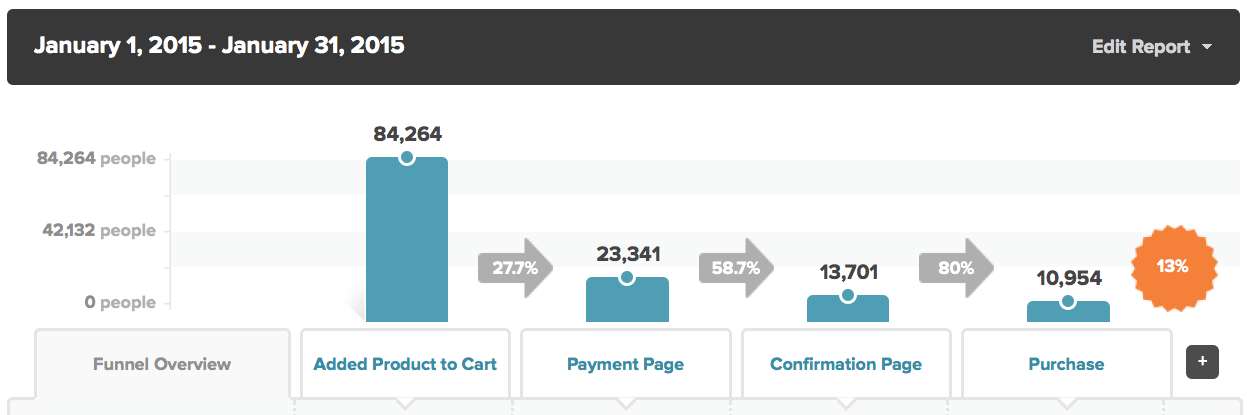
Looking at this graph, where would you say drop-off is occurring?

Without question, most people who end up putting a product in their cart don’t even advance to the next step in the funnel (the Payment Page). If we can increase the people who convert from the Added Product to Cart page to Payment Page, we’ll have a pretty linear increase in purchases.

So if you’re a marketer and you want to increase conversions (who doesn’t), here’s what you do:

  • Use the Kissmetrics Funnel Report to see where visitors are dropping off.
  • Run A/B tests on those pages. Track the tests in the Kissmetrics A/B Test Report. The more tests you run, the more winners you’ll find, and the more purchases you’ll bring.

With Engage from Kissmetrics, you’ll be able to put modals on your site that can increase conversions. A lot of our customers have experienced a conversion boost by using Engage.

The best marketers are able to drive loyal customers. Lucky for marketers, Kissmetrics has a report that shows marketers where their most loyal customers come from.

Click here to watch a short demo of the Kissmetrics Funnel Report.

3) Cohort Report – Find Customers Who Repurchase

Businesses live and die on their ability to attract and retain customers. To track customer retention, marketers can create a cohort report that shows them how often customers come back and repurchase products. They can even group them together and see which products or product lines have people coming back for more.

A cohort is a group of people who share a common characteristic or experience within a defined period. For example, people who purchased from your site during April are in a cohort because they all did one thing (purchase) during a defined period (April).

Taking this a step further, the Kissmetrics Cohort Report allows you to group people by any characteristic and then segment them by any property. Let’s see this in action.

We want to track repurchase rates (i.e., people who purchase, then purchase again). We can find those people, but what do we group them by? Time? Marketing channel? Product? Product category? As long as you’re tracking the property in Kissmetrics, you can segment people by it.

Let’s use marketing channel as our example. This segments people by the channel they came from. The higher the percentages (darker shade of blue), the better.

channel-purchases-cohort-report-kissmetrics

On the left side we get the number of people from each channel who have purchased. This is not a traffic report. We’re looking at purchases. We see that most of our purchases are from people in the Social channel. The right side (all the blue shaded cells with percentages in them) shows us how many of those people came back and purchased again, by month.

Social looks like it delivers a lot of purchases and repurchases. If we can acquire more people from this channel, chances are we’ll be acquiring loyal customers. The more targeted we can make our marketing, the more loyal customers we’ll attract. And businesses that win have loyal customers.

As mentioned above, we aren’t limited to grouping people only by channel. We can group them by product (see which products get the most repurchases), product line, any UTM parameter, time, etc. As long as you track it, you can get the data that matters to you.

Click here to watch a short demo of the Kissmetrics Cohort Report.

4) Revenue Report – See Which Products Bring the Most Valuable Customers

Your revenue is probably coming from dozens (hundreds) of sources. Maybe a feature on CNN got you a ton of orders, or you get a lot of purchasers coming from Google searches.

The Kissmetrics Revenue Report is used to segment your revenue and see which sources are bringing you the most valuable customers. Here is how it could look for a company selling clothes:

kissmetrics-revenue-report-ecommerce

We’re segmenting revenue by collection (aka product category). The In-House Generic Tees bring tons of revenue (over $630k) and customers (over 9,700). The other metrics (average revenue/person, lifetime value, and churn) tell us how valuable these collections are for our business. We want high numbers on average revenue/person and lifetime value, but low percentages for churn. (Churn represents the percentage of people who ordered from that collection but did not order again within a defined time period.)

Just like the Cohort Report in the above section, we aren’t limited to segmenting only by collection. We can also segment by marketing channel, so we can see which channels bring us the most valuable customers. By the way, the channels property works automatically in Kissmetrics. There are no custom rules or custom code needed.

Click here to watch a short demo of the Kissmetrics Revenue Report.

5) People Search – Find People Who Have Abandoned Their Cart

The biggest problem for a lot of ecommerce companies is customers who abandon their cart. They view a product, add it to their cart, but never return again. They’re missing out on a big opportunity if they don’t make an effort to re-engage these people. If marketers can get them re-engaged (through cart abandonment emails) they are giving themselves a better shot at recapturing these lost orders.

The problem for many marketers is they don’t know where to start to get a list of these people. The Kissmetrics People Search makes this process easy. All you have to do is set your criteria to get a list of people you are looking for. There is no need to bug engineers to run a SQL query.

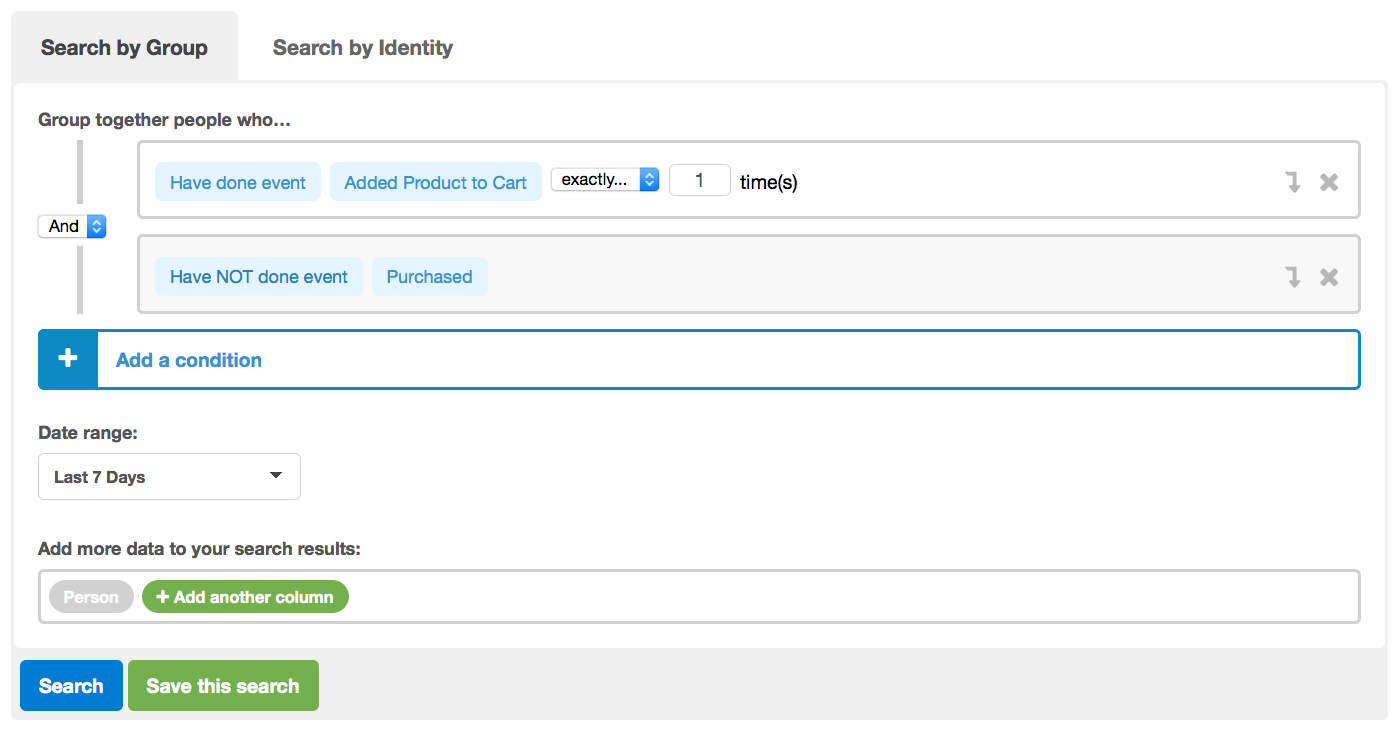
Here’s what our criteria looks like. We’re looking for people who have added a product to their cart but have not purchased. We want to see all the people who fit this criteria in the past 7 days.

people-search-add-product-to-cart-ecommerce

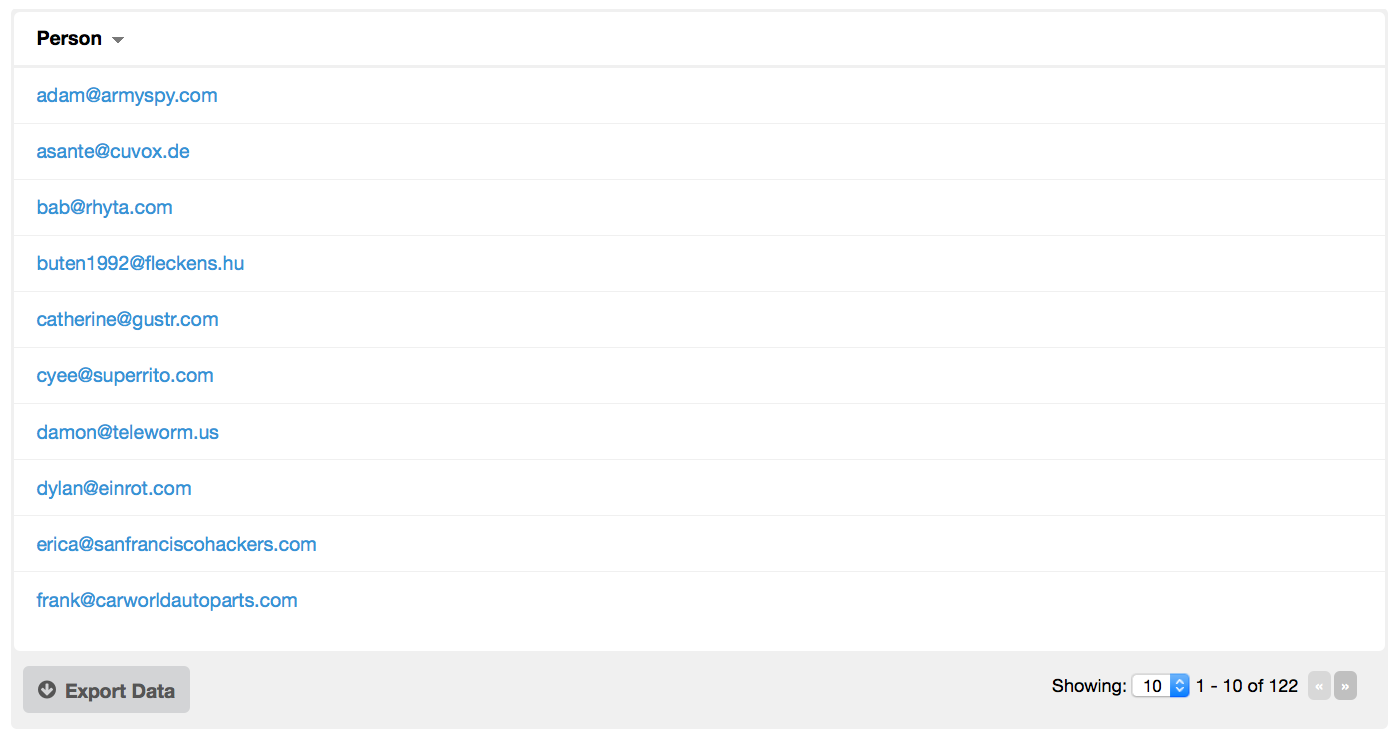
We click Search and get our list of people:

people-search-kissmetrics-cart-abandonment

There are a few things we can do with this list:

  • We can click on each person and get a Person Details report. This will show us all the events and properties the person triggered (i.e., what they’ve done on the site) as well as tell us the last time they were seen.
  • We can export the list to a CSV file and then upload it into an email service provider like MailChimp and send an email to each person to get them re-engaged and hopefully recover some lost sales.

Important note: You’ll get a list of email addresses only under certain circumstances:

Click here to watch a short demo of the Kissmetrics People Search.

Optimize Your Marketing with Kissmetrics

These are just a few examples of what Kissmetrics can do for ecommerce companies. Our reports are more than useless metrics – they provide insights into how users are behaving on your site. Once you see this data, you’ll know what needs to be improved. Once you see this data, you’ll know what needs to be improved.

Head on over to the Demo site and see how Kissmetrics works for ecommerce sites. Or better yet, schedule a personalized demo.

Ready to get straight into the action? Just click the button below to sign up for a free 2-week trial of Kissmetrics.

cta-6-11-2012

About the Author: Zach Bulygo (Twitter) is a Content Writer for Kissmetrics.

How Email Works: Part Two

In part one of this series, we looked at what happens to an email marketing message from the point when you hit "send." Now we'll follow the email as it reaches its recipient.

How To Save Up To 70% On Your Usability Testing

Posted by Gab-Goldenberg

You likely recognize the value of usability testing services, but the pricing of the most popular services is holding you back. However, there's a way to do such testing at a reasonable cost without compromising on quality.

For the sake of comparison, I'm going to look at two tool different usability testing tools in this post: UserTesting.com and TryMyUI.com. Both tools currently offer remote usability testing with screen and audio recording. During a test, the user is instructed to think out loud as they try to accomplish the tasks you assign them. There are other usability testing tools on the market, but they are priced for the enterprise-level customer, with more complex offerings that cost thousands (or tens of thousands) of dollars a year.

  • UserTesting charges $49 per test. You can also order credits in bulk (20 at a time for $900) to bring the cost down to about $45 per test.
  • TryMyUI charges $35 per test. You can also pay $300 per month for 10 testing credits, bringing the cost down to $30 per test. However, you would have to test and iterate two to three times per month to make this valuable, a scenario that usually only occurs in big organizations with incredible traffic.

Typically, you need three to five tests for each round of testing (enough to observe patterns in your site's biggest problems. Supposing you want to continuously improve your site's quality and conversion rates, then you might do a round a month, or a round every two to three months. If you only order three tests at $35 each fours times in a year, then that's $420 per year. At the other extreme, testing five users per month, you're spending up to $2,700/year. (5 x $45 x 12 = $2,700.)

What if you could perform usability testing at a fixed cost of $15 per year, plus $5 to $10 per test? You'd then spend $135 per year perhaps (3 testers x $10 x 4 rounds + $15 flat fee). At most, it would cost you $615 (5 x $10 x 12 months + $15).

Depending on the volume of your testing needs, that's an annual savings of $285 to $2085.

Smart, affordable usability testing

Here's how to reduce your usability testing costs and justify to your boss why you should get a juicy, paid holiday.

First, to know how to reduce our costs, we have to know what we're getting with the above services. What are you paying for?

You get mainly two things from existing testing tools:

1) Screen and audio recording software that will result in your usability testing videos hosted on the tool's server (at least temporarily)

2) Recruitment of users to do your tests

Until recently, the second point was an especially big hassle because recruiting people was difficult to arrange.

Enter Amazon's Mechanical Turk, or MTurk for short.


amazon-mechanical-turk.png

MTurk is a crowdsourcing tool that allows you to farm out various tasks to members of their user testing panel known as "Turkers". You make an account, deposit money, and then type out exactly what you want the Turkers to do. MTurk is the middleman that provides you with access to a humongous array of people. In exchange, MTurk takes a 10% cut on any work that's completed and approved.

MTurk makes recruiting dramatically easier

A large part of the savings comes from your being able to pay $10 per test. (And if your tests are shorter than the standard 10 to 15 minutes, you can offer even less compensation.)

What about recording the screens and audio?

Screencast-o-Matic (SOM) offers recording for $15 per year, or $30 for three years. Similar to existing remote usability testing tools, SOM will host your videos on their server and/or allow you to download them.

What about screening to get representative users for the test?

It's true, both UserTesting and TryMYUI offer to screen your testers. You want representative testers, don't you? So perhaps there's still a reason to pay them a premium for recruiting?

However, the screening process offered by those tools is just based on a simple form. You can get equivalent results by having Turkers fill in a demographics questionnaire, and assigning what's known as a "qualification" to those that meet your demographic criteria. Then you post your testing task with the qualification requirement.

If you want to get more into the details of screening Turkers, I shared some tips on it in this Give It Up presentation to SMX Israel last year (where I first shared my ideas on getting cheaper usability testing):

Here are the slides I used, so you don't need to squint at them in the video—especially the ones with tips on screening Turkers.

[Note: I no longer work for Internet Marketing Ninjas.]

Going back to the question of representative users, usability pioneer Steve Krug says to "recruit loosely, and grade on a curve". Is domain knowledge relevant to every single task? Probably not—it's most certainly not necessary for uncovering usability problems with your site.

Other details

The above advice regards website or desktop app testing.

If you want to do usability testing on mobile apps, I don't know whether or not Screencast-o-Matic can record app use on a phone or tablet if the app is running on the the operating system rather than the browser. (Incidentally, if this is what you need to do usability testing on, check out this post on mobile usability issues.)

TryMyUI, however, does have nifty features that work within Apple's limiting terms on third-party apps collecting user data from another app.

I haven't discussed post-testing surveys because they're kind of secondary. If you want these, include them in your MTurk task description for testers to do after using your site, and of course pay accordingly.

A neat feature that both sites offer in various formats is customer experience analytics. These allow you to gain insight into customer experience without watching all of the recorded footage. If you're testing three to five users per round, that will save you from 45 minutes to more than an hour of video watching time. An even better option is to hire two to three Turkers to watch the videos and find the patterns.

I've also done data analysis on Excel spreadsheets with Turkers, and it's been great. Plus, you're getting fresh eyes to look at the videos.

The testing described above is basically what you see described in Steve Krug's guide to usability testing, Rocket Surgery Made Easy.

If you'd like to download sample usability testing task descriptions to use on MTurk, you can get them at cro.seoroi.com/mturk-doc.php.


Sign up for The Moz Top 10, a semimonthly mailer updating you on the top ten hottest pieces of SEO news, tips, and rad links uncovered by the Moz team. Think of it as your exclusive digest of stuff you don't have time to hunt down but want to read!

Wednesday, July 1, 2015

Millennials: The Shopping Cart Masters

Millennials may abandon their online shopping carts, but reminder emails should take the right tone - this demographic is far more likely to revisit those carts, even on another device.