Wednesday, June 8, 2016

6 Unscalable Tactics That Will Get You More Customers

The biggest problem most businesses have is getting more customers.


Business owners believe that if they could just find that one magic growth tactic, their business would be set.


Unfortunately, the vast majority of them will never find that tactic.


And while they're searching for that magic bullet, they're passing up on smaller, unscalable tactics that could be getting them a consistent stream of new traffic.


The confusion mainly comes from misinterpretation of the concept of growth hacking:


image06


The only real condition to growth hacking is prioritizing customer/user growth above all else.


However, too many marketers seem to believe that growth hacking must involve rapid, viral growth that makes or breaks the company.


Sometimes, maximizing your growth potential means focusing on unscalable tactics. They cost more per acquisition but deliver customers when other tactics are failing.


These are best applied early on in a business, when scalable tactics (advertising, really high quality viral video campaigns, etc.) are not realistic.


I'm going to share 6 unscalable tactics that are often very effective for young businesses looking to grow. Probably, not all of them will apply to your business, but you should be able to identify at least a few you can try. 


1. Trialists rarely leave for no reason


It makes me want to bang my head against my desk.


via GIPHY


Some marketers are so focused on getting new customers that they don't realize that what happens after a signup or purchase is the most important factor behind growth.


Growth comes from creating a product that is as close to the needs and wants of your customers as possible.


You can't create that kind of a product going on intuition, without any actual customer feedback.


No feedback is feedback: If someone signs up for a demo or a trial or purchases something from you, that tells you something.


It tells you that:


  • They need a solution to a problem you're trying to solve.

  • They like the sound and/or look of your product.


But if a customer stops using your product right after they start using it (particularly for software products), that's your feedback.


Their problem didn't just disappear. What happened is they concluded that your product couldn't help them sufficiently.


What's the point of getting new customers if you barely retain any of them?


On top of that, you need to absolutely thrill customers if you want them to recommend you to others.


The solution? Get feedback: As long as you collect email addressed when people sign up, you can contact them.


If a large portion of your new signups are disappearing on you, personally send them an email and find out how your product fell short.


The customer is still in “pain” because they haven't solved their problem, which makes them pretty receptive to outreach.


It's not scalable to email every single new customer you get, but this type of feedback is how you'll make your customers love your product. You could even survey a fraction of your customers and still get really valuable feedback.


You can also preemptively get feedback by sending your customers a welcome email, asking them how they found you and what they're hoping your product can do for them.


Here's how Groove did it with great success:


image01


Try something similar, and you'll get a high response rate with great feedback.


2. Don't be afraid to sell one-on-one at first


I've started many companies at this point, and believe me, they weren't all successes at first.


It's a huge job to start a business from scratch. Getting customers is just one area, but it is indeed very difficult since you don't have your perfect product yet or any word of mouth in most cases.


Sometimes, you can throw money at advertising and get your growth off the ground.


Sometimes you can't. Whether it's because of your budget or because of your product, advertising isn't always a great option.


An option that I recommend is to have one-on-one conversations with your potential customers.


Where do you find them?


  • Forums

  • Sites like Reddit

  • LinkedIn, Facebook, and other social media sites

  • Friends in real life


Let me give you an example. Say you're selling a website builder. You could spend time on the startups and entrepreneur subreddits, forums such as Warrior Forum, and many groups on LinkedIn and Facebook.


It will take time, but you'll come across questions and conversations like this one I pulled from Reddit:


image04


Someone was looking for a website builder with search functionality.


Then, you can send the user a message. Something like this:


Hey, I saw that you were trying to create a search based website. I actually have a lot of experience with that sort of thing and even built a website builder for that specific reason.


I'd be happy to answer any questions you have about it. Just send me your email address, and we can hop on Skype or Slack or have a quick email chat.


Regards,


Neil


Note that everything in this message is about how you can help them, and not the other way around.


It's much easier to sell to someone when you have their full attention during a chat, and especially when you're actually providing them with additional help and guidance.


3. Make customers come back with a little extra effort


Like I said above, the customer experience after they try or purchase something is what leads them to become return customers and to start talking about your product to others.


One way you could make sure they end their experience on a high note, which will encourage them to talk about your business and come back, is with a handwritten thank-you note.


Unless your customers are very young, handwritten letters are typically perceived as a caring, personal gesture.


For example, this is a simple card that a Jawbone customer received:


image07


When the recipient of the note posted the above photo on Twitter, this one tweet resulted in over 100 shares (at the time of writing).


While a card will take you a few minutes to write and send (if you batch them), it will return much more to you if do it well.


Could this be scaled? If you have thousands of customers, it'll be hard to write a real letter to each of them.


Some businesses, such as Bond and MailLift, offer services that will write the letters for you. You just need to provide the addresses and names:


image05


Ideally, you don't want to be writing the same thing to each customer. So, while this is an option, it's not quite as good as writing your own letters.


4. Trade your product for something more valuable


I mentioned it earlier: it's tough to get customers for a new product with no customer base.


People want to see that others have had a good experience with something before buying it themselves.


Translated to marketing, this is social proof, primarily seen in the form of testimonials and case studies.


image03


Both can provide assurance to potential customers considering buying from you and often have a large impact on conversion rates.


You have to give to get: Great testimonials or case studies are worth several times the cost of your product.


One option, early on, is to give away your product or service in return for a testimonial or case study.


The hard part is finding a way to actually get this offer in front of people.


It will depend on your product.


For some, you can simply make a forum post or Reddit thread and offer a few samples of your product (say 5-10) to any users willing to give you feedback. You can get their emails and go into more details later.


If that's not an option, you need to be more creative:


  • Offer it to anyone who contacts you with questions about the product.

  • Install live chat on your website, and offer products to anyone who engages.


image00


  • Actively reach out to customers if possible (say you sell a product for bloggers)


Most people are pretty receptive to trying something for free.


Once you've invested in these testimonials or case studies, you need to make sure they're effective. Luckily, I've written about it in the past:


5. Have a broad market? Consider stickers…


I've mentioned Reddit a few times in this post as well as many of my other posts. Reddit is now one of the largest sites in the world.


Do you want to know how Reddit got off the ground?


In 2005, the two co-founders got $12,000 from Y Combinator.


That's $12,000 for the whole business, so not a ton to go around. They were left with $500 for a marketing budget.


They promptly spent that $500 on stickers of their alien mascot:


image02


They plastered them in public everywhere they could and handed out the rest at events or to random people on the street.


Soon after, stickers started showing up on social media and other websites, and people learned about Reddit. The picture above is of Wil Wheaton in the background of a sticker.


I love this idea because you'll always stand out. Just make sure that your site or product is identified on the sticker and that it ends up in view of the people you're trying to target.


The Reddit stickers worked out well because they were placed on bus stations and buildings on college campuses. Reddit had a pretty broad audience, even at the start, but primarily focused on young, tech-savvy users (college students).


You don't necessarily have to use stickers. You could try:


  • Backpack or luggage tags

  • T-shirts or hats

  • Bracelets

  • Glow sticks


Be creative.


6. Get out and speak


Speaking at events comes with a lot of benefits.


For one, it may lead to direct payment, which alone is highly rewarding.


But when you're first starting out, the biggest benefit is having an audience in front of you.


Most crowds consist of customers and peers (other businesses in your industry).


As a speaker, you position yourself as an expert-an expert with whom many people in the audience will want to do business.


If you have something to sell to those businesses, you'll almost always make some sales. More importantly, you can find ways to work together.


For example, a real estate agent could partner up with a home decorator. The home decorator could touch up houses for sale and leave business cards or pamphlets for people the agent shows the houses to.


The agent gets a better looking house to sell, and the decorator gets more customers. Win-win.


Where do you start if you want to speak at conferences? Unfortunately, you can't just jump in and speak at the biggest ones in your industry.


You're starting from the bottom, and you need to start with whatever experience you can get.


Focus on getting experience first so you can leverage it later to get speaking opportunities at bigger events. If you can get customers from these first few speaking gigs as well, that's just a great bonus.


To find a list of conferences actively looking for speakers, Google “(industry) conferences speaker proposal”:


image08


Put in some decent effort into your proposals, and you'll get at least a few chances to speak.


Here are some quick tips on how to increase your chances of being invited to speak:


  1. Stick to the requirements – Different conferences want to know different things about their speakers. Always read all the details they provide, and try to describe yourself according to them.

  2. Don't be a generalist – Never submit a proposal and call yourself something like a “marketing expert.” Instead, pick a specific area, e.g., “influencer marketing expert.”

  3. Your bio leaves a mark – You'll get a chance to submit a bio most of the time. Put emphasis on your most impressive professional accomplishments.

  4. Talk specifics – Part of a proposal is a topic you could speak about and a short description. Try to think of something unique that the audience would love. That way, no other speaker could fill your spot.


Apply to several conferences at the same time because they can take a little while to get back to you.


Conclusion


Scalable growth is sexy, but it's not always possible.


If your business is still struggling for customers, don't be afraid to use unscalable marketing tactics.


I've shown you 6 in this post, so you should be able to get working on at least one right away.


If you have any experience with unscalable growth tactics, I'd love it if you shared your creative ideas in a comment below.


Wednesday, May 18, 2016

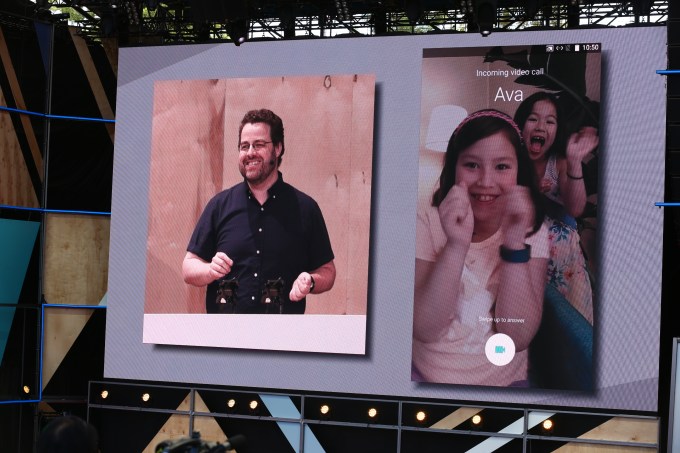
Google shows off Duo, its new HD video calling app and answer to Apple's FaceTime

O92A6133 Some have criticised Google for falling behind when it comes to social networking and new communications services, but the company is how working hard to catch up. Today, the company announced a new video calling app called Duo - a high-definition app for Android and iOS devices. Duo was unveiled on the heels of Allo, Google's new smart messaging app. Why the decision to launch… Read More

Monday, May 9, 2016

Big Periscope updates: Streaming from drones, videos won't disappear

Drone
Feed-twFeed-fb

Facebook Live might be the hottest live-streaming app right now, but Periscope is raising its game to meet the new challenge.


The Twitter-owned streaming app gave Mashable a look at three new features it plans to roll out over the next few weeks. The service will soon support streams from drone cameras as well as let all users automatically save their broadcasts permanently on the service (which rolled out in beta last week). Also on deck: New search and sharing features that'll make it easier to find good things to stream.


More about Dji, Drones, Periscope, Social Media, and Twitter


Friday, April 29, 2016

The $100,000 Challenge: March Update

march update


We finally finished the last month of the $100,000 challenge. March was an awesome month for Nutrition Secrets. Not only did the traffic grow to 218,811 visitors, but revenue did too-it went up to $121,492.65.


It wasn't hard to hit the revenue goals as we had enough fish oil in stock, plus we started to generate money from affiliate sales.


So let's dive right in…


Traffic


Compared to February, the traffic went up to 218,811 visitors and 269,814 pageviews. The increase was only 18,102, which isn't much.


But considering that the popularity of nutrition and fitness sites is cyclical (January and February are most popular) and that Mike didn't blog much on NutritionSecrets.com in March, it wasn't too bad.


Overall, Mike has slowed down on the blogging front. Over the next few months, he wants to try a few fun content formats such as infographics and wants to see what happens if we were to dump a few hundred grand into the blog. It won't be much of an experiment at that point, but we are just curious to see if we can get the blog to a million visitors a month.


traffic sources


Nonetheless, the traffic isn't performing too badly. Even in April, the traffic has been on an upward trend while little to no effort has been put into the blog since the challenge has been over.


Revenue


The revenue is a bit more complicated to breakdown as it is coming from two sources now: Amazon and affiliates.


In March, revenue from Amazon hit $112,573.30.


amazon revenue


There are a few key elements to growing Amazon sales:


  1. Reviews – the more people you can get to leave a review, the better off you are. Most people don't even read the reviews, but if they are high in ratings and you have tons in quantity, you are in good shape. If you have a blog that's driving sales, a great way to get more reviews is through marketing automation. You can promote the product to your email list, and then after a few weeks of promoting your product to those people, you would send an automated email asking them to leave a review. You won't really know who bought the product, but you would still put the review email-applicable to a portion of your list-in your sequence.

  2. Keywords – with Amazon, you can add keywords. Most people add basic ones like “fish oil,” but as you know, it is all about the long tail. Amazon opened it up so you can stuff hundreds of keywords now, and with the use of Google Keyword Planner, you can come up with popular variations. You'll then start ranking for tons of keywords on Amazon.

  3. Combating negative Amazon reviews – similarly to what happens when people employ negative SEO, competitors sabotage your Amazon listing by taking up your front page with terrible reviews. They do this to tank your sales so they can generate more income. You fight this by building up your email list on your blog and continually blasting out to your list when you have bad reviews, asking your readers to up-vote the positive ones.

  4. Ads – Amazon allows ads on its platform. Whether it is profitable or not, ads help you generate more sales. And if you can increase your sales velocity, you'll find that your listing climbs up higher and starts to stick-it stays up there even after your ads stop showing. Sure, other people can do the same thing, but most don't.


As for affiliate income, we started to push stuff by the Truth About Abs guys. We started doing email blasts to our list in order to generate the sales, and it has been working out well. The copy isn't too bad, but there are two reasons it's working out well.


aweber


  1. We collect a lot more emails – we are generating 300 to 400 email sign-ups a day. It's much larger than our previous numbers for one reason: we turned off double opt-in. Aweber usually requires double opt-in when you use third-party software to collect emails, but Mike called Aweber and got them to disable double opt-ins.

  2. Good copy – our copy converts well. You can see an example email below. And we have many more emails like this in the sequence. So, we continually send you affiliate offers over time, which helps.


Here is the email copy we have been testing:


Email – This plant food HARMS your metabolism & heart


Hi {!firstname_fix}


Sometimes it's not the enemy you know that's the problem, but the friend you think you know.


In this case, I'm talking about nutrition in foods. It's common knowledge that stuff like sugary drinks are just plain bad for you. The best you can say is that your body can absorb the bad effects if you only have them occasionally.


But what about foods you thought weren't bad, and you heard were actually good for you?


I have some bad news, and some good news. The bad: some so-called “healthy” foods may be the cause of why you work so hard to eat healthy and haven't seen the results you expected. The good news: There's a solution I read about from best selling author Mike Geary.  Read on… (removed affiliate link)


Email – 2 Simple steps to REMOVE visceral belly fat (the DEADLIEST type)


Hi {!firstname_fix}


People often refer to past times as “the good old days” with a nostalgic tone. At least when it comes to many nutritional and health practices, I think of them more like the “bad old days.”


For example, people thought the wonders of science had delivered new, healthy products called “trans fats” that were featured in margarine, to replace that nasty butter. We now know that trans fats are about the worst thing you can coat your innards with.


People also thought they could do “spot reducing” of unattractive belly fat by using those jiggling-belt machines, or some other gimmick.


Well, belly fat certainly is still unattractive, and research says it's also a danger sign. But research has also identified more-effective ways of getting rid of that spare tire. Here's how. (removed affiliate link)


Email – 7 “fatty” foods for a flat stomach


Hi {!firstname_fix}


I spend full time on nutrition- and health-related activities. That's the business I'm in.


I'm also an improvement junkie, always looking for the latest, best information. So you can imagine that I've pretty much seen it all: Every product, every supplement, every type of exercise.


Most of them are underwhelming. Yawn.


I'm writing you today because I recently came across something that made me sit up and pay attention. It's a short-term blueprint for eating the right foods to burn substantial fat, and it's all explained here… (removed affiliate link)


You can find high converting offers on sites such as Clickbank. They even sort the offers by popularity. I need to get a screenshot of our Clickbank revenue and our other affiliate income sources from Mike as he created the accounts and has the logins. Once I do, I will update the post with a screenshot (we use three networks).


The total affiliate revenue was $8,919.35.


Profit


As for monthly profit, it was high…but for a different reason than you might think. When you sell tangible products, you buy tons of inventory and then sell it over the following few months. We didn't want to be out for our last month, so we spent a good chunk of money in the previous month, and, of course, we bought more in March.


Here is a breakdown of the expenses:


  • Fish oil – $68,492.52 (including Amazon fees, shipping to Amazon for Prime, coupon-related expenses, and producing more inventory)

  • Aweber – $149

  • Designer – $375 (continually tweaking the site)

  • Hosting – $249

  • Mike – free (Mike doesn't get paid, but he owns a percentage of the blog)

  • Accounting – $290 (we are now paying a bookkeeper to help out with the books)


Total expenses came out to $69,555.52.


That brings the total profit to $51,937.13.


Of course, to maintain the growth, we would have to keep buying fish oil, but after awhile, we would cap out on sales, and our margins should be a healthy 30% plus. As for March, I didn't spend much on buying tons more inventory as I wanted to show that selling supplements can be profitable.


Conclusion


Overall, the $100,000 challenge was fun, but I wouldn't do it again. It's just too much work with everything I have going on.


It was still a good learning experience. One thing I realized is how much harder it is to rank on Google today compared to 5 years ago. Almost all of my sites are old, so it is much easier for them to rank.


And although NutritionSecrets.com generated good traffic, if it were 5 years ago, the blog would have been at a million visitors a month with the same amount of effort.


So, what do you think of the $100,000 challenge?


Thursday, March 10, 2016

How ClickMechanic Uses Kissmetrics to Grow

When I tell others my company grew its conversions by 20% month on month, they usually ask me two things: “What should I track? And how often should I track it?”


Like all great advice, the answer is simple: it depends. But, the answer is most certainly not to track everything. Because when you track everything, you actually optimise nothing at all.


Our company ClickMechanic is an online marketplace where you can book a mechanic to repair or service your car. So we’ve found the health of our business relies on three KPIs:


  1. Conversion rate

  2. Customer acquisition cost

  3. Lifetime value


If you can make a decent margin on a customer’s first transaction, then you need to understand how that plays out in the LTV of a typical customer. If the cost to acquire that customer is relatively low–AND if these customers purchase from you repeatedly–then you’re going to have a healthy business.


But if you have a high acquisition cost and you’re not making any margins on the first transaction and/or your customers leave after the first transaction, you’re going to find yourself in trouble.


Like most startup founders we meet, we use Kissmetrics for funnel analysis and understanding our customer lifecycles. We use Google Analytics to see a snapshot of our top trends.


How often we track these metrics (hint: it’s not every week)


Every business is different. Ultimately, it’s up to you to experiment and find a system that works for you.


Here’s what our 3-part system looks like:


  1. We review our KPIs every 10 days–the beginning, middle and end of the month. This 10-day check involves someone from sales, customer experience and marketing.

  2. We have individual meetings with each of the key areas where we can drill down, stemming from these 10-day check ins.

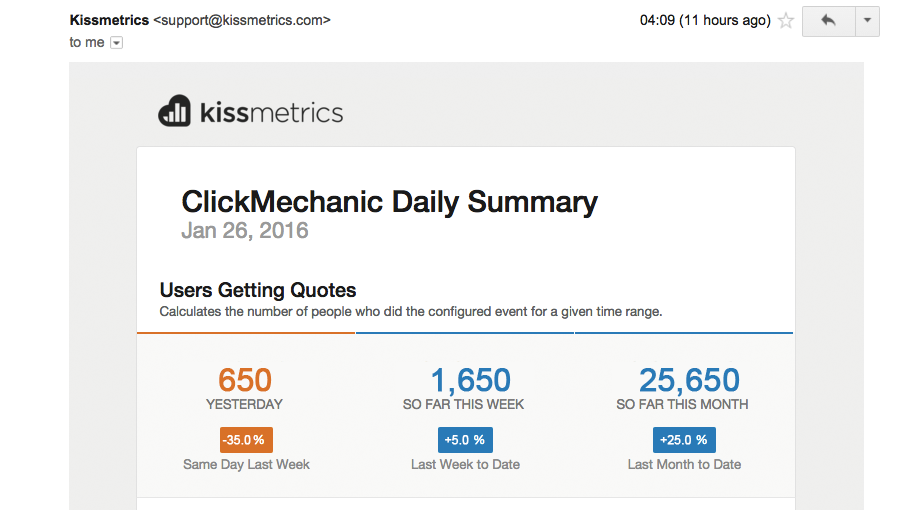
  3. And of course, I always talk w/ my co-founder constantly about these KPIs. This isn’t a set calendar meeting. It’s something we endlessly enjoy talking about, thanks to our daily summary emailed to us every day:


clickmechanic-kissmetrics-email-summary


In our 10-day check in, we look for spikes in acquisition costs, dips in conversion, and dig down into what might have caused that. That allows us to keep track of our targets.


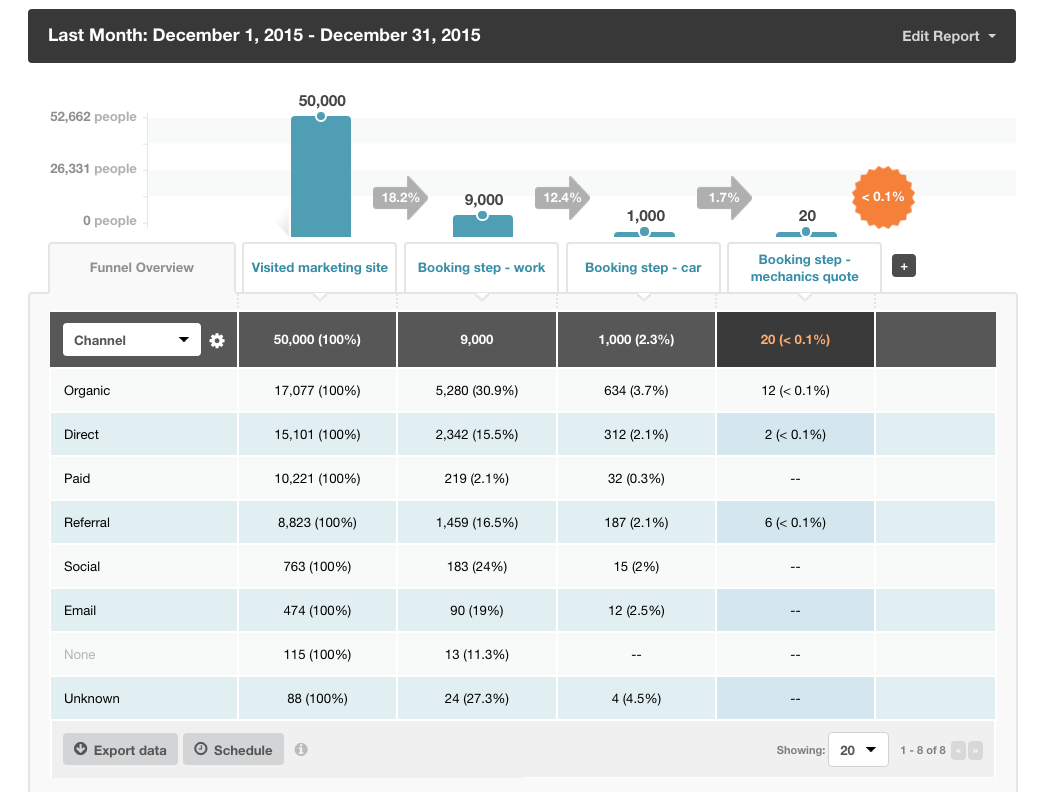
For example, we’ll look into dips in conversion in the Funnel Report:


clickmechanic-kissmetrics-funnel


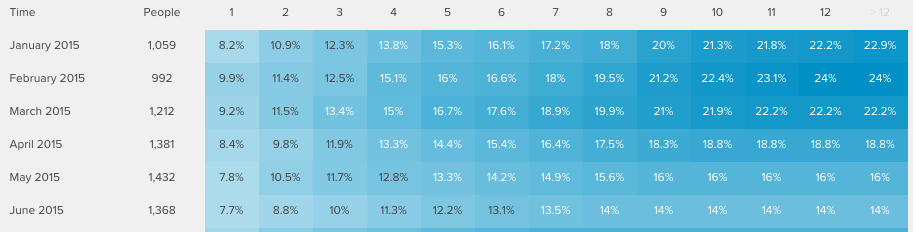
Or, for us to see if our customers are returning customers, we look at the Cohort Report:


clickmechanic-cohort-report-kissmetrics


Why every 10 days? If we can see 10 days in that we’re 5% down on what our run rate needs to be the month, then we know we have to find different ways to get our conversion back up.


In these meetings, we’ll ask:


  • What’s hurting us? Is it conversion?

  • Is it a particular channel?

  • Are the landing pages in paid search performing well?

  • Is a particular product not converting well? Do we need to review the copy?

  • How do we fix it?


We used to analyse our data monthly, but it’s not enough! Once the month is finished, it’s too late once you have those insights to hit your target.


So the secret to this growth story isn’t a secret at all. For us it boils down to: 1) knowing our customers inside and out, 2) being able to dig into the data to answer our questions (and take action!), and 3) sticking to a 3-part system that works for us.


Free Webinar


Signup for the webinar recording to see the other ways ClickMechanic uses Kissmetrics to grow their business.


Monday, March 7, 2016

Be Bold: 4 Uncommon Types of Content That Attract Hundreds of Backlinks

links


If you want great backlinks in the modern SEO world, you need great content.


It’s as simple as that.


Those links improve your search engine rankings and send you droves of referral traffic.


Really, all the posts you read on content marketing come down to two things:


  • how to create great content

  • how to promote it


They can both get pretty complex when you dive into them.


Here, I want to focus on the first point.


Specifically, I want to talk about what types of content outperform all others.


I get hundreds of emails a day from bloggers asking for links to their latest “epic” guide.


I check out as many as I can, but most aren’t nearly as epic as the creators believe they are. In fact, they’re all almost identical.


If you want to be successful with your promotional efforts, you need to have something truly worth promoting.


That means you have something that’s unique, special, and valuable. And it needs to be something that people care about.


It’s no easy feat, but that’s your goal.


Out of those emails I get every day, 99% contain links to your standard blog post/guide type of content.


I love blogging—I really do—but if you want to stand out, you should also consider creating other forms of content.


There are four in particular that are really effective, and I’ll reveal what they are in this post.


Be warned, though: the reason why these types of content aren’t produced as much as others is because they are much more difficult to create than your standard blog posts.


They will cost much more time and money to produce, but they will also produce exponentially more links and revenue.


They’re not for the lazy, but if you’re ready to put in some work, let’s get started. 


Type #1: Tools rule in terms of value


It’s tough to define what a member of your audience would deem valuable, but it correlates with the usefulness of your offer to them.


Blog posts can be very valuable if they help a reader overcome a big problem.


This very post could be worth tens of thousands of dollars to you if you actually implement the advice. I’d say that’s valuable.


But many blog posts aren’t actionable even if they’re well written.


On the other hand, tools are almost always useful because they have a specific purpose and use.


How many bloggers or businesses do you know that have created tools for their audiences?


My guess? Not many.


Not only are such tools useful but they are also rare, which makes them even more special.


Let’s look at a few so you have a clear picture of what I’m talking about.


Take a look at the tool from Keywordtool.io:


image06


This was made back in May of 2014.


According to Ahrefs, at the time of writing, it had over 25,700 backlinks, coming from 3,860 linking root domains.


Can you imagine getting this many links from a series of blog posts, no matter how “epic”?


This keyword tool takes a simple concept, but it executes it well. You enter a keyword into the text box, and the tool will generate a list of keyword suggestions based on autocomplete suggestions.


Basically, it goes to sources such as Google, enters your keyword, and then looks at the suggestions that pop up.


image00


If you hire a typical developer, this kind of a tool would take about 2-3 weeks to create and cost around $5,000 (my estimate).


Based on that cost, the creator has been able to get links for 19.4 cents a piece. Or, in terms of linking root domains (LRDs), it’s $1.75 per linking root domain.


And these aren’t low quality links. On top of that, I’m sure he’s been able to sell a good number of premium memberships (a few extra features), while also drumming up some advanced keyword research projects for other businesses.


One more example (a personal one…): If you go to the Quick Sprout homepage, you’ll see the Quick Sprout tool, which you may or may not know about.


It takes your domain name and generates an incredibly detailed SEO and site performance report:


image07


It wasn’t cheap to make. In fact, it cost me over $100,000.


I include it here to illustrate that you can go as big or as small as you’d like with tools.


Small tools that cost a few hundred or thousand can still get a great amount of attention, but bigger tools usually get more.


Even though the tool is free, the leads that it has generated have already produced several times what I paid to have it created.


That’s the most important conclusion here: Tools can be used not only to get backlinks and traffic but to also produce revenue.


Blog posts convert at lower rates, and while they can produce a solid return on investment (ROI), it doesn’t compare to tools.


Are tools perfect? It’s only fair that I tell you about the potential downside of tools as well.


First is the potentially high cost. You’ll need to invest quite a bit before you ever see returns.


Secondly, results are never guaranteed. Not all tools are well received or popular, so you risk creating a tool that your audience doesn’t love.


However, if you really understand your audience and apply lean marketing principles, you can reduce the risk of this considerably.


Type #2: Viral story videos (almost commercials)


I think many people forget that videos and commercials are still a form of content.


Yes, people don’t like most commercials they see on TV, but smart marketers have figured out that there are certain types of ads that people love.


They’ll share these, link to them, and help them go viral.


My favorite example of this is Dollar Shave Club’s ad campaign.


Their first video came out of nowhere and was enough to establish the company as a household name:


image04


This wasn’t a typical commercial about shaving blades, with all sorts of close-ups. You know the ones I’m talking about…


image05


Instead, it’s an immensely entertaining video starring the founder.


They don’t include the standard platitudes that viewers are sick of hearing. Instead, they’re authentic.


I strongly encourage you to watch the full video now, before moving forward:


This video alone has received almost 22 million views along with 9,520 backlinks from 1,760 domains:


image08


It’s true, creating a video like this isn’t cheap.


It will cost tens of thousands of dollars, and that’s why most businesses don’t even attempt it.


However, if you have the budget, it’s a great option. Just remember to also budget for the initial promotion (that hopefully pushes the video viral).


Type #3: High quality images are more valuable than ever before


I’m not sure why this idea did not take off in the past.


It’s not new.


The strategy is to create a whole bunch of custom images that bloggers in your niche would love to use.


Once you do, you let them know about the images and say they can use any of them free as long as they link back to your site, giving it credit.


If you’re a blogger, you know how hard it is to find great custom images, let alone free.


That’s why this is such an easy sell.


But now, I think this strategy is more effective than ever before.


There have never been more bloggers creating content on a regular basis. That’s one factor that raises the demand for images.


Additionally, most of those bloggers are realizing that quality is the most important factor in their success. That applies to both their writing and the images they use. This creates even more demand for high quality images.


If you can provide that, you will be successful.


Stock images suck, go for custom: There are tons of free stock image sites out there with the same old pictures of models dressed up, faking some pose.


There’s a reason why readers hate these: they look fake and unrelated to the content.


You could customize those stock images, but that’s more work than most bloggers are willing to put in.


Your best bet, when using this strategy, is to create a ton of custom images relevant to the topics that bloggers in your niche write about.


Here’s an example of one that I used on one of my past posts:


image02


As you can see, it doesn’t necessarily have to be complex to look nice and enhance the content.


Take image building a step further and make images for stats: One specific approach you could take is to create images, essentially mini-infographics, that summarize important industry stats.


This approach has one huge bonus.


Think about a time when a blogger is searching for a good stat to use.


They head to Google and search for something like:


content marketing challenges stats


A good portion of the time, they will look for good images to include with the stats they find (I know I do):


image03


If they see a good one, they’ll click on it and go through to the page that hosts it:


image01


In this case, that page would be your gallery.


As long as you ask nicely for a link in exchange for the picture, you’ll usually get it.


The big benefit is that it’s easier to rank in image searches than regular results.


On top of the links you get from emailing specific bloggers, you’ll get links naturally from people who find your image gallery through this process.


But don’t rely on image traffic: If you want to control your ROI from this project, you need to promote your gallery to bloggers yourself.


Make as big of a list of bloggers as possible, and start emailing them with a message like this:


Subject: I made a free gallery of custom (niche) images


Hi (name),


I know that it’s tough to find or create great images to use in blog posts, so I thought I’d do something for the (niche) community.


I’ve hired a designer to create a ton of custom images, some of which will probably be perfect for future posts you write. (I can’t use them all myself!)


The only catch is that I’d appreciate a link back to the gallery when you use a picture.


I’ll also be removing each picture once it’s used a few times so that none of them become too common.


If that sounds like something you’re interested in, let me know, and I’ll send you the link.


Cheers,


(Your name)


Type #4: Stats will drive the future


The final type of content that isn’t created as often as it could be is a list of stats.


Good bloggers love stats and will link to a source when they use a particular statistic in their content.


If you collect a ton of stats on different topics in your niche, they will often link to your page as a reference (on top of the original research studies).


For example, in a health niche, you could create stats for things like:


  • junk food consumption in 2016

  • average amount of protein in diets of different countries

  • number of vegans in 2016 (or over the years)

  • average minutes of exercise that people get per day


Think of stats that bloggers will be looking for.


To make it even more effective, conduct original research: The real power comes when you conduct your own surveys and data analyses.


Then, when a blogger wants to cite a stat from that research, they will link back to your site every single time.


You can easily get hundreds of links (or many more) if your research provides a useful, interesting result.


One business who does this sort of thing is Buzzsumo.


You may remember them because I wrote a post that summarized their research on over 1 billion Facebook posts.


Since they emailed me their findings directly, I didn’t link back to a specific page on their site. Instead, I just linked to their homepage multiple times, which is even better for them.


While I can’t say exactly how many links that research got them, I can confidently say that it’s in the thousands by now.


That kind of research is difficult, but if you’re willing to put in the effort (and maybe hire a data scientist/programmer), it’s possible.


Conclusion


I warned you, none of these content types are easy to produce—that’s why they’re not common.


However, they all can produce tremendous ROIs.


When done right, each of these types of content can attract hundreds (or thousands) of links and lead to greater profits.


I realize they’re not simple to do, so if you need some guidance, let me know where you’re stuck by leaving a comment below.