Saturday, July 11, 2015

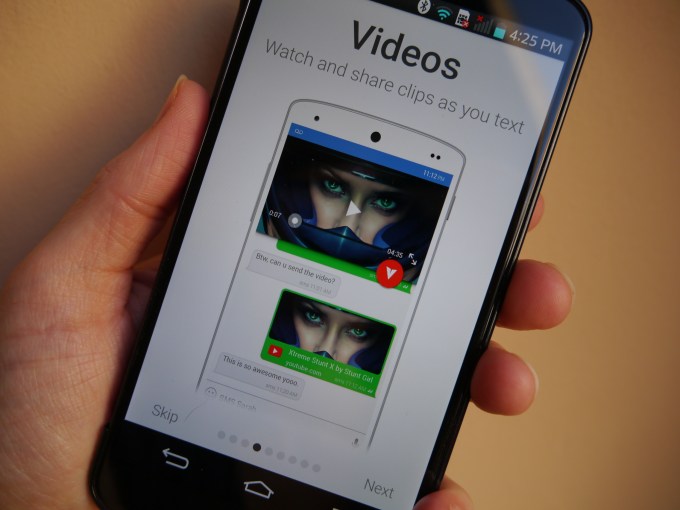
Invi’s SMS Replacement App For Android Exits Beta, Still Dreaming Big

Invi U.S. startup Invi reckons there’s space for one more messaging app play. Not a little one either. Co-founder Iddo Tal sees a gaping hole in the market for a North America-focused messaging platform giant to flourish — and, he hopes, become a global marketplace for content distribution. Such stuff startup dreams are made on. Read More

Thursday, July 9, 2015

The Mobile Data Management Platform (eBook)

As users spend more time engaging with media on mobile devices, brands are, not surprisingly, increasing ad spend on mobile platforms. In 2014, almost 20 percent of worldwide digital ad spend was projected to be allocated towards mobile, and this figure is expected to rise to 36 percent globally, and 49 percent in the US by 2017.

The above is the opening line of the Introduction of new eBook: The Mobile Data Management Platform.

By now, of course, marketers are fully aware that A) there is a whole lot of data floating around and B) a good portion of it comes from all the mobile devices that more and more people are using every single day.

The question becomes: How, as a marketer, do you get a handle on all this data and utilize it to its fullest advantage?

Enter the mobile data management platform, or mobileDMP, a centralized platform that ingests, organizes, and segments an advertiser’s first- and third-party mobile and desktop audience data assets in one place for audience creation, analytics, and execution.

Many brands today use mobileDMPs to:

  • Build sophisticated audience segments across first- and third-party data for precision at scale.
  • Create, optimize, and activate cross-platform mobile and web campaigns for consistent messaging across all consumer touch points.
  • And a lot more.

The Mobile Data Management Platform eBook sheds light on mobileDMPs and answers the following questions:

  1. What main features should a mobileDMP offer?
  2. How marketers can benefit from adding a mobileDMP to their current marketing mix?

Plus provides key insights into the three phases involved in implementing a mobileDMP as well as a mobileDMP checklist.

Now if anyone out there is still on the fence as to just how massive mobile data is and will become, consider that by 2018*, the total volume of monthly mobile data traffic is forecast to be about half of an exabyte. If this volume of data were stored on 32GB iPhone 5 devices stacked one on top of the other, the pile would be over 283 times the height of the Empire State Building.

* Source: Big data for development: Facts and figures

Wow! Facebook Completely Changed the Way Advertisers Are Charged

Are you advertising on Facebook? You probably should be, since we all know that organic reach is dead, and everyone including your mother and her close friends are spending a significant amount of time on the social platform each day.

Well, for those of you intelligent individuals that already are, Facebook just revealed some shocking news. They’ve completely changed the way advertisers are charged per click!


Wipe the sweat away from your forehead, and stop running towards your computer to pause all of your Facebook campaigns: this is actually great news and will likely improve your ROI.

What’s Changing?

Facebook, similar to AdWords, operates on a cost-per-click (CPC) model, which previously charged for every action including clicks to links and apps, likes, shares, comments and even “continue reading.” Yesterday, they announced that in order to help advertisers better understand how effective their ads are in driving goals, they’ll only be charging for clicks to websites and apps. Hoorah!

So, what counts as a click again? Facebook clarified, “we’re updating CPC to only account for what we call ‘link clicks’ – i.e., the clicks related to certain ad objectives.” These include clicks to visit a website, call-to-action clicks, clicks to install an app, clicks to Facebook canvas apps, and clicks to view a video on another site. Basically any clicks that take your off the page onto another site (or into apps).

What About the Advertisers That Value Ad Engagement (likes, shares, comments, etc.)?

What it comes down to is the fact that likes, shares, and comments are not revenue-generating actions, and often mean nothing to the majority of advertisers.

Who wants to pay for likes and shares anyhow? It’s simply more logical to pay for traffic that is actually being directed to your website or an app that you desire your user to install. It will make the life of the advertiser easier when evaluating spend and effectiveness of the campaign as well. “Taking engagement actions out of the calculation makes it easier to evaluate performance-driven campaigns and set bids based on those desired outcomes,” says Marketing Land’s, Ginny Marvin.


But what about those advertisers that are focused on branding and reputation? Luckily these advertisers will still be able to target ads and bid for engagement, but these actions will no longer be tied to the CPC. “If an ad has lots of likes and shares, that’s a signal of high-quality content being delivered to the right people,” says Facebook. “It’s also important to remember that having lots of likes and shares on an ad or post is rarely and end unto itself. The most important factor for an ad’s success is bidding for the correct business objective.”

Facebook makes a valid point here! All too often advertisers are far too focused on followers, likes, and shares, when at the end of the day if they’re not getting traffic and conversions on their site, their main business objectives are not being met.

Twitter also made a similar change last year with objective-based campaigns.

Will Advertisers Really Save Money?

At the end of the day, most likely. CPC’s will be higher, and CTR is likely to decrease when likes, shares, etc. are taken out of the CPC equation. With that said, an advertiser will only be paying for more valuable, action-oriented actions, which will likely result in higher returns. So with higher returns and no longer having to pay for simple engagement actions, it’s likely that most advertisers will save and make more money.

“Advertisers should be happy because they want to back these buys into actual metrics – no one has been able to figure out the value of a like or a comment so it makes sense to pull that metric out,” entrepreneur Krishna Subramanian, told Business Insider. “Which will drive up conversions with clicks that truly matter and create more competition for true CPC campaigns because FB provides tremendous scale.”

Once these changes are implemented it’s critical to keep in mind that comparing past historical performance with current performance will become illogical. Luckily, “The new numbers should be a truer reflection of how their campaigns are meeting business performance objectives without being muddled by actions better associated with branding goals,” says Marvin.

What's the Timeline on These Changes?

Well, that depends on how you buy ads. If you buy ads directly through Facebook’s Ads Manager or Power Editor, keep an eye out for any updated CPC implementation news, which should be coming within the next few weeks. Facebook has ensured that they will be providing messaging within the interface once the change has occurred.

For advertisers buying through a Facebook Marketing Partner, Facebook recommends speaking with your Marketing Partner to understand when they’ll be implementing the new API with updated CPC.

Lastly, those that buy through the API can begin buying ads with updated CPC today!

I’m curious, what are your thoughts on Facebook’s new CPC model?

About the Author:

Margot is a Content Marketing Specialist at WordStream with a background in PPC, SEM, content and digital marketing. Margot is passionate about writing and is also a regular contributor to Search Engine Journal and socialmediatoday.com. Margot was recently named the 25th Most Influential PPC Expert in 2015 by PPC Hero. She enjoys running and eating ice cream during her free time (not simultaneous although that would be impressive). Follow her on:

Twitter: @ChappyMargot

Google+: +Margot da Cunha

LinkedIn: http://www.linkedin.com/in/margotdacunha

Likes Aren’t Enough. Now Facebook Pages Need You To Add Them To “See First”

Facebook See First Facebook told businesses to buy Page Likes for years, saying that’s how they could reach people through the News Feed. But over time, a natural increase in competition for space in the feed plus increased restrictions on promotional and marketing posts have eroded the reach of Pages, and subsequently some of the value of Page Likes. Now Facebook has created an echelon above Likes. A new… Read More

What are your favorite memories of San Diego Comic-Con?

Comiccon-memories
Feed-twFeed-fb

With more than 40 years of events under its belt, San Diego Comic-Con has left millions of people with a boatload of memories. There have been some huge moments at Comic-Con — from the very first time Star Wars footage was unveiled in the 1976 convention to when the Avengers cast was announced in 2010 — but everyone who's been there has their own favorite memories, both big and small.

Mashable asked Quora users about some of their favorite personal memories throughout the years. Here is one user's response:

Read Heather Wilde's answer to What are some favorite memories or moments from San Diego Comic Con? on Quora Read more...

More about Entertainment, Social Media, Celebrities, Comic Con, and Film

Google’s Direct Answers: How to Keep Visitors Coming to Your Site

Posted by Daniel_Morgan

As Google continues to expand its Knowledge Graph, one of the most significant developments has been that of the Direct Answers Box, which was also recently added as a new component to the 2015 edition of Search Engine Land’s much-loved Periodic Table of SEO Success Factors.

Instead of writing about how to get your content featured in the Direct Answers Box, I thought I would focus specifically on what can be done to ensure your content is displayed properly for a high click-through rate (CTR).

There has naturally been a mix of opinions among SEOs about the rights and wrongs of Google essentially scraping content and serving up the answers directly in the search engine results pages (SERPs). Personally, I think there are a few key points to bear in mind:

  • Google won’t be dropping Direct Answers anytime soon. Instead, they are expanding the pool of queries for which it appears and improving it.
  • People often need more than just a few bullet points or sentences to be satisfied with an answer. The Direct Answers Box gives people an introduction to your main article, and is why optimizing it to make it as enticing as possible is crucial.
  • As search becomes more semantic, “how to” queries and the like will only increase in volume
  • Your article does not need to rank #1 organically to be displayed in Direct Answers, which means you potentially can enjoy greater visibility than competitors who out-rank you!

Title tags and URLs

Like a regular search result, the Direct Answers Box displays the title tag and URL, with the title serving as anchor text for the all-important link to your site. Writing these semantically and concisely will give you the best chance of having a high CTR.

how-to-tie-a-tie-big.png?date=2015-06-15

Paragraph tags

Always make sure that the paragraphs of text within your articles are enclosed with opening <p> and closing </p> tags. I’ve known a number of content writers over the years who have incorrectly used line breaks <br> to create new paragraphs.

In the example below, the very first sentence of a Wikipedia article has been used for the Answer Box. Ensuring that every one of your articles has a strong, concise opening sentences enclosed within <p> tags is recommended. However, do bear in mind that if an opening sentence pulled for an Answer Box answers a search query too concisely, it could mean that the user will not feel the need to click through to your website to read the full article.

what-is-a-double-breasted-jacket.png?dat

Ordered and unordered lists

The proper use of HTML list tags is also important to remember when optimizing your content for Answer Boxes. The ordered list <ol> tag is best for articles that provide users with a series of sequential steps such as “how to change a tire” or “how to make a pancake.” Unordered lists (<ul>) are more appropriate for a series of bulleted points.

If you don’t use these tags, your content will look as if it's been forced into place, rather than deliberately laid out in an orderly fashion. You can see here that (as you would expect) Martha Stewart is badly in need of an HTML refresher...

how-to-knit-2.png?date=2015-06-15%2021:1

...whereas the team at DIY.com clearly knows their stuff.

how-to-fit-shelves.png?date=2015-06-15%2

Compressed images

Images are also sometimes displayed in Direct Answers alongside a paragraph of text. I’m not sure exactly how Google determines which queries should show an image, but it's particularly common for images of diagrams to be displayed. That said, other types of images can also be displayed in Direct Answers, as this example shows:

how-to-tie-shoelaces.png?date=2015-06-15

Google is all about quick loading times, and they’re not going to sacrifice this to display your high-resolution images in the Answer Box, no matter how beautiful they are. In fact, it seems that Google favors GIFs over other file formats. Yes, GIFs! At the expense of resolution and quality, GIFs are data-compressed, which results in a relatively tiny file size compared to a PNG, for instance. For diagrams and simple images, GIFs more than suffice.

earthquakes-prism.png?date=2015-06-15%20

Call-to-action links

add-negative-keywords.png?date=2015-06-1

The screenshot above was taken from a search result for ‘’adwords negative keywords".

These blue links were first spotted in Google’s SERPs back in February 2015, but don’t seem to appear for a great deal of queries. It appears they are reserved for the most authoritative pages on the most authoritative domains. If, in the future, Google Webmaster Tools (recently rebranded as Google Search Console) allowed us to directly optimize these links, it would go a long way in making SEOs more comfortable with Direct Answers in general.

Videos

Disclaimer: I haven’t actually seen or heard of any videos being featured in Direct Answers. However, I am sure it is only a matter of time before they are featured, given that video is a format that works well for how-to guides.

Searches for how-to queries on YouTube (which, let’s not forget, has its own search engine that rivals all others in terms of usage) are up 70% year over year. Given that Google owns YouTube and is already giving YouTube videos preferential treatment in blended search results, adding video content to Direct Answers seems like a natural next step.

Even if videos don't get added to Direct Answers, video can still be a great way to gain visibility for "how to" queries and similar searches. Just think about the impact of effectively owning Google’s search results for a given query—your content displayed in Direct Answers, ranking in first position underneath Direct Answers with your YouTube video, thanks to Universal Search.

Conclusion

Most of the recommendations covered in this post happen to be best practices for writing evergreen content, which means they are beneficial to implement regardless of whether you want your content to appear in the Direct Answers Box.

I also want to take this opportunity to say that the example queries used above in no way reflect my own personal searching habits. I do know how to tie my shoelaces, and have no interest in learning how to knit. :)

Finally, here are the key takeaways from this post:

  • Make sure you and your content writers are using the right HTML tags (e.g., list tags) within the articles you publish online. Head over to Codecademy for a free basic HTML course if needed.
  • If your article includes diagrams or other simple graphics, try converting them to GIF format to reduce file size
  • Ensure that each article has a concise opening sentence that include the article’s main keywords
  • If you have evergreen articles on your site, but no videos, change that

Sign up for The Moz Top 10, a semimonthly mailer updating you on the top ten hottest pieces of SEO news, tips, and rad links uncovered by the Moz team. Think of it as your exclusive digest of stuff you don't have time to hunt down but want to read!

Wednesday, July 8, 2015

I Can Has New CEO? Cheezburger’s Ben Huh Steps Down After 8 Years

4059113868_88c6710239_b After acquiring a tiny little site called I Can Has Cheezburger? in 2007, Ben Huh took it to levels that went way further than the internet. The site, and at one time Huh himself, were a bit of a household name. Today, he has announced that he’s stepping down as CEO, to be replaced by its President and COO Scott Moore. Before there was Buzzfeed, before there was every Huffington Post… Read More